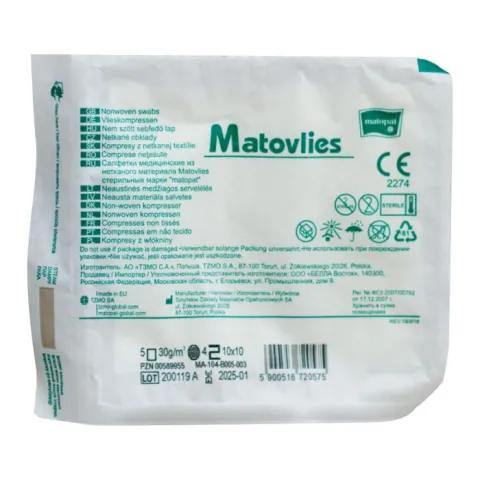
The swab may be the simplest consumable in a practice, but ordering it correctly involves three decisions: sterile or non-sterile, gauze or non-woven, and how thick, meaning how many layers. This guide explains what the word “sterile” on the label guarantees, how cotton gauze differs from PPSB non-woven, how to read plies, layers and threads per cm², when you need an X-ray detectable thread and what to check on the packaging.
In short
- A sterile swab stays sterile only while its packaging is intact; an opened pouch no longer protects the swabs left inside.
- Procedures that require aseptic technique need sterile swabs; for hygiene, cleaning and protection, non-sterile ones are enough.
- Gauze is woven cotton; PPSB non-woven is made of pressed polypropylene fibers and sheds less lint.
- Plies and layers give the thickness of the swab, threads per cm² the density of the weave.
- On sterile packaging, check the sterilization method, lot, expiry date and the CE mark with the notified body number.
Sterile and non-sterile: the real difference
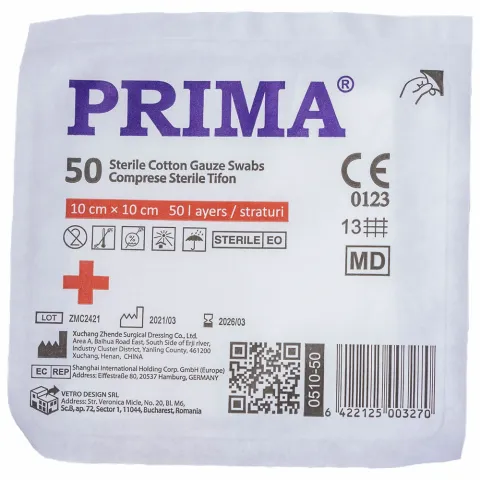
A sterile swab has been sterilized by the manufacturer and packed in packaging that keeps it sterile until it is opened. Regulation (EU) 2017/745 requires the label to state the sterile condition and the sterilization method, and the sterile packaging to show, among other things, the month and year of manufacture, the use-by date and a reference to the instructions in case the packaging is damaged or opened by mistake. The sheet for the 40 × 60 cm PRIMA PPSB swab says it plainly: the product is sterile as long as the packaging is not damaged.
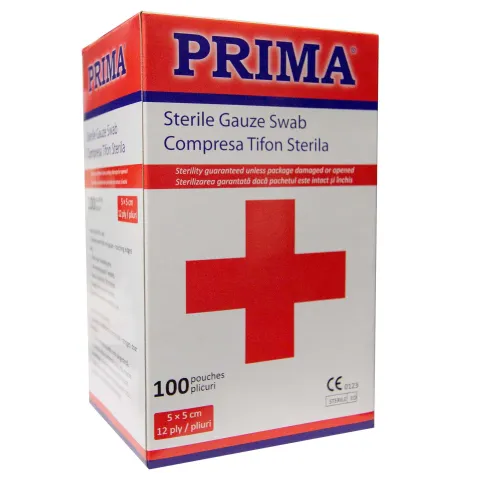
That is where the practical packaging rule comes from. Swabs left in an opened pouch are no longer protected by the sterile packaging, so choose the pack size by how many swabs you use per procedure: the catalog ranges from a single swab per pouch to boxes of 32 pouches with 2 swabs each.
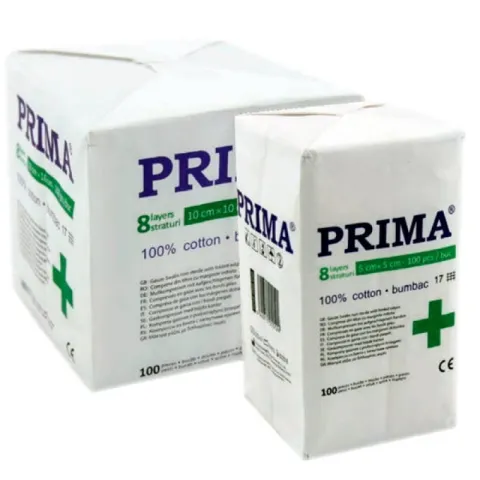
Non-sterile swabs usually come in packs of 100, without a sterile barrier: they are made of the same materials, without the sterility guarantee.
When to use each type
Which swab is used for a given task is set by the unit’s protocol. The basic rule and the usual allocation:
| Situation | Swab |
|---|
| Surgical and invasive procedures, sterile field, aseptic technique | sterile, gauze or non-woven; in surgery, also with X-ray thread |
| Wound care | according to the unit’s wound care protocol; sterile where the protocol requires aseptic technique |
| Outer layer over a sterile dressing, protection, absorption on intact skin | non-sterile |
| Cleaning, hygiene, work with no sterility requirement (for example in beauty salons) | non-sterile |
Gauze or non-woven
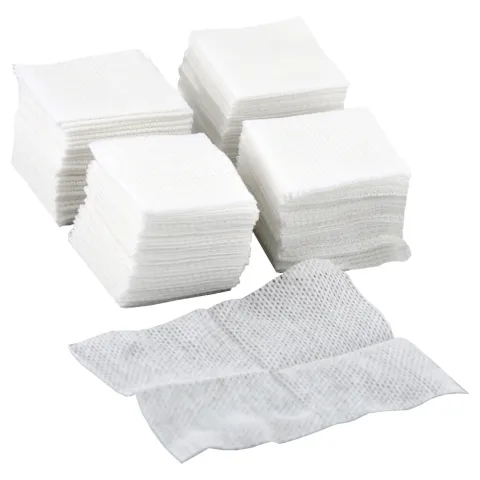
Gauze swabs are woven from cotton; the PRIMA ones are 100% cotton with the edges folded inwards, and the sheet for the sterile ones states that they leave no lint. Non-woven swabs (PPSB, polypropylene spunbond) are made of pressed rather than woven fibers. Their product sheets in the catalog state that they shed less lint and leave fewer fibers in the wound on removal than woven material, and that the compact structure can be cut without fraying.
| Criterion | Cotton gauze | Non-woven (PPSB) |
|---|
| Material | woven cotton | pressed polypropylene fibers |
| How thickness is given | plies or layers (8, 12, up to 100 on large swabs) | folded in 4 or 8 layers |
| How the material is described | threads per cm² (13 or 17 on PRIMA swabs) | weight in g/m² (30 g/m² on the sterile non-woven swabs) |
| Formats in the catalog | 5 × 5, 7.5 × 7.5 and 10 × 10 cm, plus 40 × 40 cm | 5 × 5, 7.5 × 7.5, 10 × 10 and 10 × 20 cm, plus 40 × 60 and 60 × 80 cm |
| Versions | sterile and non-sterile | sterile and non-sterile |
The catalog also has sterile absorbent cellulose swabs (Abena), from 10 × 10 to 20 × 40 cm, and large sterile PPSB swabs of 40 × 60 and 60 × 80 cm for covering large areas.
Gauze and non-woven swabs, sterile and non-sterile
Plies, layers, threads per cm²: how to read the label
- Size: 5 × 5, 7.5 × 7.5, 10 × 10 or 10 × 20 cm are the usual formats.
- Plies or layers show how many times the material is folded, so how thick the swab is. PRIMA non-sterile gauze swabs have 8 plies; the sterile 5 × 5 cm ones have 12 layers; a large 40 × 40 cm swab has 100 layers.
- Threads per cm² describe how dense the gauze weave is: PRIMA sheets state 17 threads per cm² for the non-sterile swabs and 13 for some sterile ones. For the non-sterile gauze swabs, the PRIMA sheets also give the breaking strength: at least 50–60 N.
- Weight in g/m² describes non-woven material: the PRIMA sterile non-woven swabs are 30 g/m² and folded in 4 layers.
X-ray detectable swabs
X-ray detectable swabs have a radiopaque thread woven in that shows on an X-ray, so a swab left in the surgical field can be located. The catalog has sterile 10 × 10 cm X-ray swabs with 12 layers, 5 × 5 cm versions and non-sterile 45 × 45 cm abdominal swabs. The PRIMA X-ray swab sheet states that the thread contains 60% barium sulphate and describes it as strong and flexible, and the swabs as sterile, single use and with folded edges.
Impregnated swabs and swabs for dental practices and salons
The same product family includes impregnated swabs, for example with 10% povidone-iodine or with burn gel. They are a separate category with their own indications, stated on each product sheet, and are not compared by the criteria above. At the other end, the non-sterile 5 × 5 cm non-woven swabs also appear in the catalog under dentistry, salon supplies and veterinary.
How to work out consumption and keep stock
- Count the procedures. For each type of task, multiply the number of procedures per month by the number of swabs used in one. For example, 15 dressings a day with 2 sterile swabs each, over 22 working days, means 660 swabs, or 330 pouches of 2.
- Round up to the pack. For sterile swabs, count in pouches, because an opened pouch cannot be kept; for non-sterile ones, in packs of 100.
- Check the storage conditions. Regulation (EU) 2017/745 requires the label to state any special storage conditions; keep swabs in their original packaging, under the conditions on the label.
- Use the batch that expires first. The expiry date is printed on the sterile packaging, at least as year and month.
Two common mix-ups
- Assuming every X-ray swab is sterile. In the catalog, the 45 × 45 cm abdominal swabs with radiopaque thread are non-sterile; read the sterile status on the packaging rather than inferring it from the type of swab.
- Comparing different offers. Two packs of 10 × 10 cm swabs may differ in number of layers, weave density or material; compare only products with the same characteristics.
What to check on the packaging and the data sheet
- Material: 100% cotton, non-woven (and which fiber), cellulose.
- Size in cm and the number of layers or plies.
- Density or weight: threads per cm² for gauze, g/m² for non-woven.
- Sterile or non-sterile; for sterile swabs, the sterilization method, usually a symbol such as “STERILE EO” (ethylene oxide) or “STERILE R” (irradiation).
- Lot and expiry date, at least year and month, plus the single-use and “do not use if package is damaged” symbols.
- Quantity: pieces per pouch and pouches per box for sterile swabs, pieces per pack for non-sterile ones.
- X-ray thread, if you need it.
- CE mark. Gauze swabs that act as a barrier or absorb exudate are normally class I medical devices under the European classification guidance MDCG 2021-24. On sterile ones, the CE mark is accompanied by the notified body number; on non-sterile class I swabs, as a rule, it is not.
To cover both situations you usually need two types: non-sterile 8-ply gauze swabs, for example the 10 × 10 cm ones, 100 per pack, and sterile swabs in pouches, such as the 10 × 10 cm gauze ones, in the quantity you use per procedure. The rest of the range, including bandages, is in the gauze swabs, gauze rolls and bandages category.
Frequently asked questions
What is the difference between sterile and non-sterile swabs?
Sterile swabs are sterilized by the manufacturer and packed so that they stay sterile until the packaging is opened; the label shows the sterilization method, lot and expiry date. Non-sterile swabs are made of the same materials but without the sterility guarantee, usually in packs of 100.
What does PPSB mean on swabs?
PPSB stands for polypropylene spunbond, a non-woven material made of pressed fibers. The product sheets in the catalog state that it sheds less lint than gauze and can be cut without fraying.
What do “8 plies” or “12 layers” mean?
They show how many times the material is folded, which is the thickness of the swab. PRIMA non-sterile gauze swabs have 8 plies and the sterile 5 × 5 cm ones have 12 layers.
Are the swabs left in an opened pouch still sterile?
They are no longer protected by the sterile packaging. Sterility is maintained only while the packaging is intact, so choose pouches holding the number of swabs you use per procedure.
What are X-ray swabs?
They are swabs with a radiopaque thread woven into the material, visible on X-ray, used in surgical procedures. The catalog has sterile 5 × 5 and 10 × 10 cm versions and non-sterile 45 × 45 cm abdominal swabs.