Sterile or non-sterile swabs: gauze or non-woven, plies and when to use each
What a sterile swab guarantees, cotton gauze versus PPSB non-woven, what plies, layers and threads per cm² mean, X-ray detectable swabs and what to check on the packaging.
We use cookies necessary for the site to work and, with your consent, for: preferences, statistics, relevant offers and maps.
You choose what we store on your device. Strictly necessary cookies always stay active. All the details are in Cookie policy.
The site does not work without them: they keep you logged in, keep your cart and the steps of a booking, and protect your forms. They cannot be turned off.
prima-shop-session · 2 hours from the last action
XSRF-TOKEN · 2 ore
remember_web_…, remember_bookora_… · 400 de zile
acord_cookie · 6 luni
Cloudflare's own technical storage · how long the review takes · their policy
They remember your choices between visits, so you don't have to make them again each time.
ps_view · 1 an
They show us, without identifying you, how many visitors we have, which pages are searched for and where people get stuck, during an order or a booking — so we can improve the site. Without consent, Google receives only anonymous signals, without cookies.
_ga, _ga_* · up to 2 years · their policy
They help us find out which ads bring in orders and show you, on other sites, products you viewed with us. Without consent, we do not measure ads on your device and you do not receive personalized ads from us.
_gcl_au, _gcl_aw, cookie-uri Google (de exemplu IDE) · up to 13 months, set by Google · their policy
Maps are provided by Google Maps. When they load, Google receives your IP address and may set its own cookies. Without consent, we only show you a link to the map or the list of locations.
cookie-uri Google (de exemplu NID) · up to 6 months, set by Google · their policy



A suture pack carries five pieces of information you need to read correctly: size, material, thread length, needle and sterility data. This guide explains the USP size system, from 7-0 up to sutures thicker than 0, how it maps to metric size, the difference between absorbable and non-absorbable sutures, how needles are described and what to check on the pack before you order.
The USP system, from the United States Pharmacopeia, starts at size 0. Thinner sutures are written 2-0, 3-0, 4-0 and so on, sometimes as 2/0, 3/0: the higher the first number, the thinner the thread. Above 0, thick sutures are numbered 1, 2, 3 and 4. The USP monographs require the size on the suture label to be given both as a metric size and as a USP size.
The metric size, shown on some packs as “EP” or “Metric”, reads directly: the number is the minimum diameter of the thread in tenths of a millimeter. A metric 2 suture is at least 0.20 mm thick, a metric 1.5 suture at least 0.15 mm.
| USP size | Metric size | Minimum diameter | Materials in the catalog |
|---|---|---|---|
| 7-0 | 0.5 | 0.05 mm | not in the catalog |
| 6-0 | 0.7 | 0.07 mm | PGA |
| 5-0 | 1 | 0.10 mm | PGA, silk, polyamide, polypropylene |
| 4-0 | 1.5 | 0.15 mm | PGA, polyglactin, silk, nylon, polypropylene |
| 3-0 | 2 | 0.20 mm | PGA, polydioxanone, silk, nylon, polyamide, polypropylene |
| 2-0 | 3 | 0.30 mm | PGA, polydioxanone, silk, nylon, polypropylene |
| 0 | 3.5 | 0.35 mm | PGA, polydioxanone, silk, polypropylene |
| 1 | 4 | 0.40 mm | PGA, polydioxanone, silk, polypropylene |
| 2 | 5 | 0.50 mm | PGA, silk |
| 3 and 4 | 6 | 0.60 mm | PGA (USP 3) |
The diameters are those in the USP tables for synthetic absorbable and non-absorbable sutures; each size has a range, and the table shows its lower limit. Collagen (catgut) sutures have a separate table: for them the same USP size corresponds to a larger metric number, so 2-0 means metric 3.5, not metric 3.
The US Pharmacopeia defines an absorbable suture as a sterile strand that can be absorbed by living tissue, and a non-absorbable suture as one that resists the action of living tissue. Which suture is used for a given wound or procedure is the doctor’s decision; for purchasing, what matters is the material, the construction and the sizes you need.
| Material | Type | Construction | What the catalog sheet states |
|---|---|---|---|
| Polyglycolic acid (PGA) | absorbable | braided multifilament, coated | 70–80% of strength retained in the first 14 days, 50% at 21 days, complete absorption usually within 60–90 days |
| Polyglactin 910 | absorbable | braided multifilament, coated | copolymer of 90% glycolide and 10% L-lactide |
| Polydioxanone (PDO) | absorbable | monofilament | synthetic violet thread |
| Silk | non-absorbable | braided multifilament, silicone-coated | moderate tissue reaction |
| Nylon (polyamide 6.0) | non-absorbable | monofilament | blue thread; polyamide is also in the catalog as a black multifilament |
| Polypropylene | non-absorbable | monofilament | blue thread |
The PGA product sheets in the catalog also state the limits of use: they are intended for approximation and ligation of soft tissue, including plastic and ophthalmic procedures, but not for cardiovascular or neurological tissue. Read the exact indications and contraindications in each product’s instructions, because they differ from one suture to another.
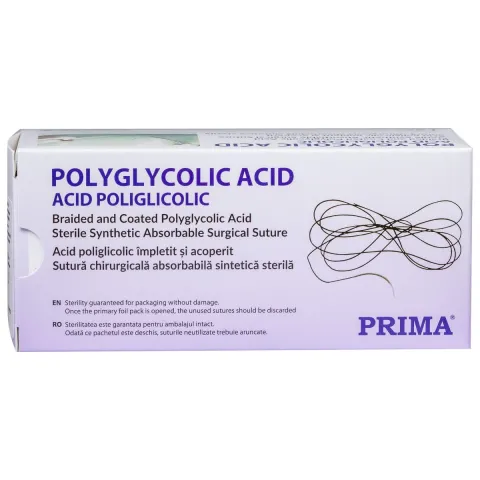
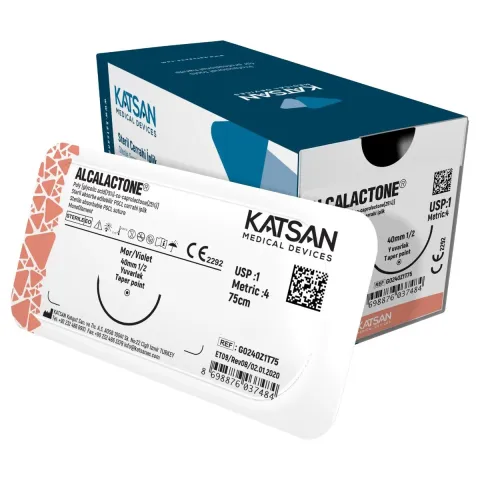
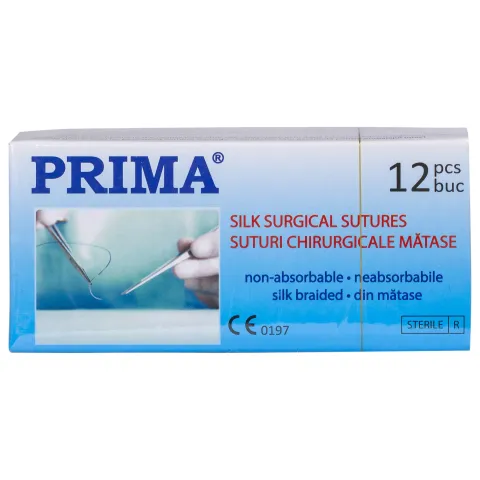
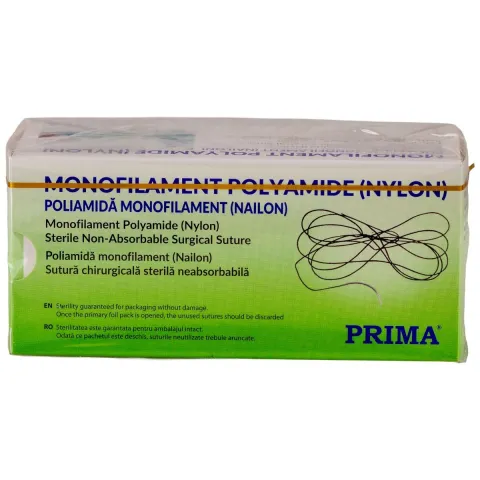
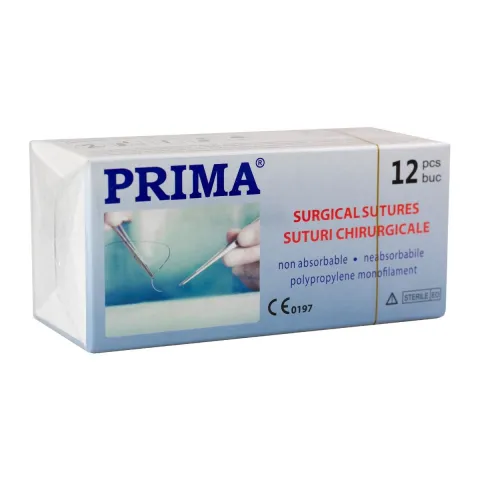
A monofilament suture is made of a single fiber, a multifilament suture of several fibers braided or twisted together. The construction is shown on the pack and on the data sheet. The braided sutures in the catalog are coated: PGA with a blend of caprolactone and calcium stearate, silk with silicone. The USP monograph allows non-absorbable sutures to be treated to reduce capillarity, the tendency to wick fluid along the fibers.
Some manufacturers summarize these details in a code printed on the pack, and the codes differ from one manufacturer to another. In the catalog of the manufacturer Assut, for example, HR-22 means a 1/2-circle needle (H) with a round body (R) and a length of 22 mm, and an added letter G marks the heavier version of the needle. When you switch supplier, compare curvature, point and length, not the code.
The needled sutures in the catalog are 70, 75 or 90 cm long, and those without a needle, used for example for ligatures, 150 cm; for veterinary use there are also 25 m reels. Many sutures are sold in boxes of 12 packs, and the exact quantity is given in the product name or sheet. Thread color also differs: PGA is dyed violet, with an undyed version, silk and multifilament polyamide are black, and the nylon and polypropylene in the catalog are blue; the manufacturers’ descriptions link color to the visibility of the thread in the surgical field. When comparing prices, work from the price per pack, not per box.
Take as examples the 75 cm PGA 4-0 suture with a 16 mm 3/8 cutting needle or the silk 3-0 suture with a 22 mm 1/2 round needle. On the pack and box, look for:
The USP monographs require each pack label to state the material, size, construction and length of the suture, whether it is sterile or non-sterile, the type of needle, the number of sutures, the lot and the manufacturer. Regulation (EU) 2017/745 adds, for sterile devices, the sterile condition and sterilization method and the date until which the device can be used safely.
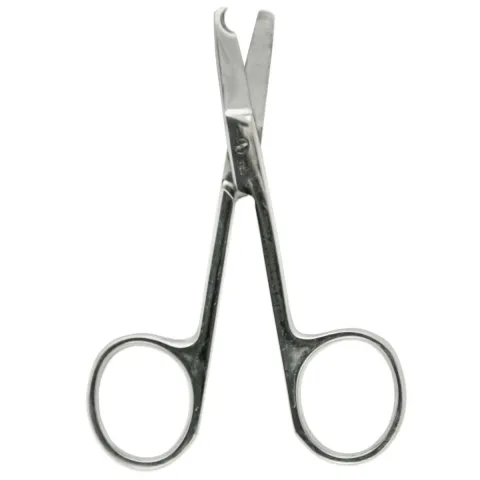
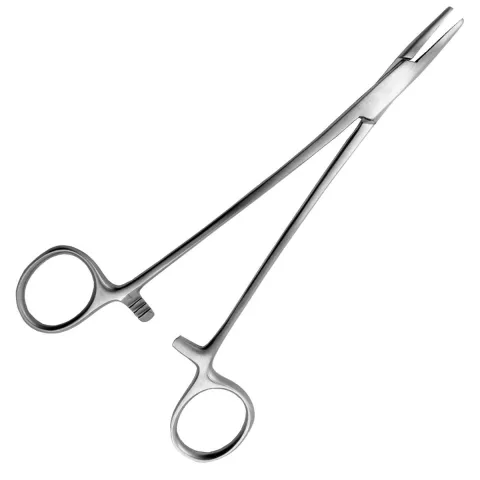
To place and remove sutures you need a needle holder, for example Mayo-Hegar or Olsen-Hegar, the latter with built-in scissors, Adson-type surgical forceps and scissors. The 9.5 cm PRIMA Littauer scissors have a notch designed for cutting and removing sutures; like any reusable instrument, they are used again only after cleaning, disinfection and sterilization. For wound closure without thread there are sterile skin staplers with 35 staples, staple removers and sterile skin closure strips.
All sutures, by material and size, are in the surgical sutures category, divided into absorbable sutures and non-absorbable sutures.
4-0 (also written 4/0) is the suture size in the USP system. It corresponds to metric size 1.5, a diameter of at least 0.15 mm, and is thinner than 3-0.
2-0. For sizes ending in “-0”, a higher number means a thinner thread: 2-0 corresponds to metric size 3 (at least 0.30 mm) and 3-0 to metric size 2 (at least 0.20 mm).
It is the metric size: the minimum diameter of the thread in tenths of a millimeter, here 0.20 mm. For synthetic and non-absorbable sutures it corresponds to USP 3-0; for collagen (catgut) sutures the correspondence is different.
In the catalog, polyglycolic acid (PGA), polyglactin 910 and polydioxanone sutures are absorbable. Silk, nylon (polyamide) and polypropylene sutures are non-absorbable.
They show the needle curvature as a fraction of a circle: a 1/2 needle forms half a circle, a 3/8 needle three eighths of a circle. The needle length in millimeters is given next to the curvature.
A round needle (RB or taper point) has a round body and passes through tissue without cutting edges. A cutting needle has a triangular cross-section with cutting edges; the Tapercut type combines a round body with a cutting tip.
What a sterile swab guarantees, cotton gauze versus PPSB non-woven, what plies, layers and threads per cm² mean, X-ray detectable swabs and what to check on the packaging.

The differences between paper, silk, cloth, transparent polyethylene and elastic nonwoven medical tape, when to use a sterile plaster, which width to pick and how to apply and remove tape without irritating the skin.

Diferența dintre recipientul de coprocultură simplu și cel cu mediu de transport (gel), cum recoltezi scaunul cu spatula, urina în urocultor și exudatul faringian, plus cum păstrezi probele până la laborator.
The recommendations on the home page help you find the right products for your practice, clinic or business faster.