Medical tape looks like a product with little variety: a white strip with adhesive. In practice, the material decides how long it holds, whether it tears by hand, whether it lets the skin breathe and how much it stresses the skin when removed. For a gauze swab changed daily on an older person's fragile skin you choose something different than for a tube that has to stay firmly fixed.
This guide compares tape materials, explains the difference between tape and a plaster, helps you choose the width and shows how to apply and remove tape. The product characteristics quoted come from their product sheets in our catalog.
Tape or plaster?
Tape on a roll
Medical tape
- Adhesive strip without a pad
- Holds gauze swabs, bandages, tubes, probes and catheters
- Cut or torn to the length you need
- Touches the skin, not the wound
vs
Adhesive dressing
Plaster
- Has an absorbent pad in the middle
- Covers a small injury directly
- Comes in pieces, usually of a fixed size
- For wounds, the sterile, individually wrapped version
The distinction also appears in Romanian law: Ministry of Health Order 987/2007 on the car first aid kit lists "tape" separately, a roll of at least 2.5 m × 2.5 cm, and "plaster (quick dressing)", at least 6 × 10 cm.
5Paper, silk, cloth, transparent, nonwoven
The materials compared
| Material | How it behaves | Suitable for | Keep in mind |
|---|
| Paper | Light, porous, highly breathable and only slightly water-permeable; tears by hand | Holding gauze swabs, frequent changes, sensitive skin | sticks well to dry skin |
| Silk | Fine, porous and strong fabric; tears by hand | Holding bandages, tubes and probes | sticks well to dry skin |
| Cloth | Fabric that does not stretch; zinc oxide or acrylic adhesive | Fixation that must last and take strain | holds long, remove carefully |
| Transparent | Polyethylene; does not stretch, and the 5 cm version lets moisture evaporate | Dressings, cannulas, probes and catheters that need watching | skin stays visible |
| Elastic nonwoven | Stretches both ways, permeable to air and vapour, pre-cut | Fixing gauze over its whole surface, on joints and awkward areas | cut to size |
| Polyurethane film | Transparent, semi-permeable, non-sterile | Protecting and fixing primary dressings | intact skin only |
Paper
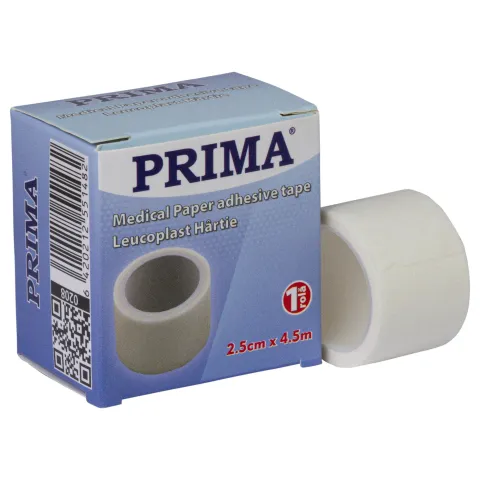
This is the basic choice for a gauze swab that is changed often. The product sheet of PRIMA paper tape, 2.5 cm × 4.5 m, describes it as porous, highly breathable and only slightly water-permeable, easy to tear without scissors and latex-free. It sticks well to dry skin.
Silk
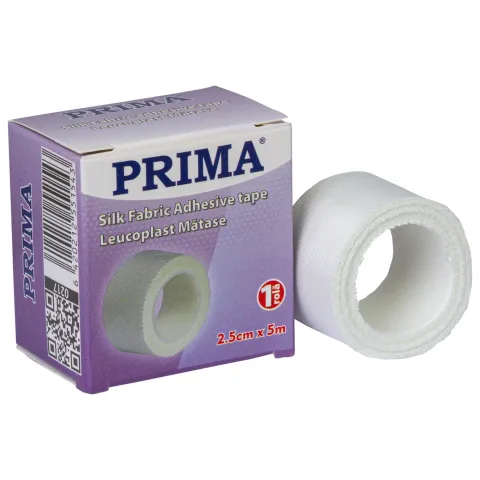
Silk tape is a fine fabric, strong under tension, that still tears by hand. PRIMA silk tape, 2.5 cm × 5 m, is intended for holding bandages; in practice it is also used for tubes and probes.
Cloth
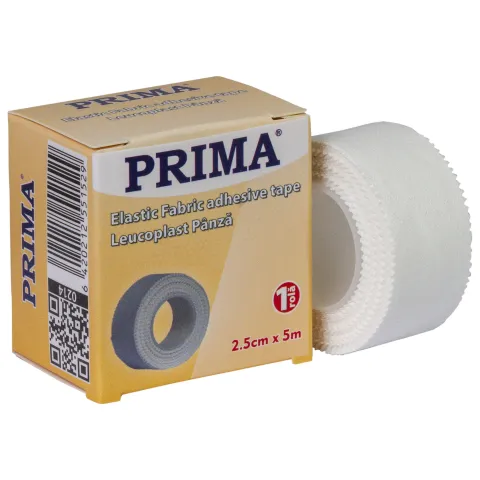
Cloth tape does not stretch and is made for long-lasting fixation. PRIMA zinc oxide cloth tape, 2.5 cm × 5 m, tears by hand, stays intact during long wear and tolerates moisture, according to its product sheet. The strong adhesion has a price: removal stresses the skin more, so for daily changes on sensitive skin a gentler material is preferable.
Transparent
PRIMA transparent polyethylene tape, 2.5 cm × 5 m, holds dressings, cannulas, probes and catheters and lets you see the skin underneath. The product sheets of the transparent tapes do not claim water resistance. For an area that needs to be watched there is also transparent polyurethane film, which the manufacturer indicates for intact skin only.
Paper, silk and cloth medical tape
Paper Adhesive Tape, 2.5cm x 4.5m, White, Hypoallergenic, for Sensitive Skin, Medical, for Securing Dressings, PRIMA
Paper Adhesive Tape, 2.5cm x 4.5m, White, Hypoallergenic, for Sensitive Skin, Medical, for Securing Dressings, PRIMA
in stock
290Lei
excl. VAT: 2,40 Lei
Zinc Oxide Cloth Adhesive Tape Roll, 2.5 cm x 5 m, White, Hypoallergenic, Medical, for Securing Dressings, PRIMA
Zinc Oxide Cloth Adhesive Tape Roll, 2.5 cm x 5 m, White, Hypoallergenic, Medical, for Securing Dressings, PRIMA
in stock
424Lei
excl. VAT: 3,50 Lei
What "hypoallergenic" meansThe term shows that the adhesive is formulated to reduce the risk of reactions, not that reactions are impossible. If you know the skin has reacted to a tape, change the material and the type of adhesive and note what you used. If you need a latex-free product, look for the statement on the packaging or in the product sheet.
Which width to choose
| Width | When to use it |
|---|
| 2.5 cm | Tubes, probes, small gauze swabs, fingers; also the width required in the car kit |
| 5 cm | Larger gauze swabs, wider fixation, bandages |
| 10–20 cm, elastic nonwoven | Fixing a gauze swab over its whole surface, on joints or curved areas |
How to apply and remove tape
- Clean, dry skinAdhesive grips dry skin; creams and moisture weaken it.
- Do not stretch the tapeApply it without tension. Stretched tape pulls on the skin for as long as it is worn.
- Leave tape on intact skinOn both sides of the gauze swab, so that the fixation does not depend on its edge.
- Press lightly over the whole surfaceThe adhesive needs full contact to hold.
- Remove slowly, almost parallel to the skinSupport the skin with your other hand and fold the tape back over itself, in the direction of hair growth, without jerking.
Plasters: with a pad, sterile, special
Plasters have an absorbent pad and are used for small injuries. For a wound or after a procedure, use a sterile, individually wrapped plaster with intact packaging and within its expiry date.
- Everyday plasters with a pad: skin-colored microperforated polyethylene, transparent, elastic fabric or paper, 19 × 72 mm or 20 × 60 mm, and 22.5 mm round plasters for injection sites.
- Sterile plasters: nonwoven, individually wrapped, from 7 × 3.5 cm to 15 × 10 cm, 8 × 6 cm plasters for securing IV cannulas and hemostatic plasters for venepuncture sites.
- Detectable plasters: blue, with metal foil under the pad, for the food industry, where metal detectors can find them.
Common mistakes
- Putting tape directly on the woundTape holds the gauze swab, it does not replace it. The wound gets a sterile plaster or gauze swab.
- Stretching the tape as you apply itThe tension stays in the skin for as long as the tape is on.
- Ripping the tape off fast, at a right angleRemove it slowly, almost parallel to the skin, supporting the skin with your other hand.
- Using zinc oxide cloth for daily changes on fragile skinThat is what paper and nonwoven are for.
- Applying tape to damp skin or skin with creamThe adhesive does not grip and the tape falls off.
- Using a sterile plaster with torn packagingSterility is guaranteed only while the packaging is intact and the product is in date.
Medical tape and plasters for the practice and the first aid kit
Paper, silk, cloth and transparent tape, elastic nonwoven fixation tape, plasters with a pad and individually wrapped sterile plasters, in the Prima Shop catalog.
Frequently asked questions
What is the difference between paper tape and silk tape?
Paper is lighter and more porous, suited to gauze swabs changed often and to sensitive skin. Silk is a finer, stronger fabric, used to hold bandages, tubes and probes. Both tear by hand and stick well to dry skin.
Which medical tape holds best?
Of the materials in this guide, zinc oxide cloth is designed for long-lasting fixation: it does not stretch, stays intact during long wear and tolerates moisture, according to its product sheet. Because it sticks strongly, it should be removed carefully and is not the first choice for daily changes on fragile skin.
Is medical tape sterile?
It depends on the product, so read the label. If the roll is not marked "sterile", do not put it in direct contact with a wound; use it only to hold a sterile gauze swab or plaster.
What does "hypoallergenic" mean on medical tape?
That the adhesive is formulated to reduce the risk of skin reactions. It does not guarantee there will be none. If the skin has reacted to one type of tape, choose a different material and adhesive.
Is transparent tape waterproof?
The product sheets of the transparent tapes in our catalog do not claim water resistance. If you need water protection, choose a product declared as such, for example waterproof sterile plasters.
Which tape width should I choose?
2.5 cm covers most fixation needs: tubes, probes, small gauze swabs. 5 cm is for larger gauze swabs, and 10–20 cm elastic nonwoven tape fixes a gauze swab over its whole surface, including on joints.