A car first aid kit is one of the three items every car must carry, together with the warning triangles and the fire extinguisher. Many drivers buy one once, put it under the luggage and only open it at a police check or after an accident, when they find expired gauze swabs, missing gloves or a cracked case.
This guide explains what the law in force requires, what the kit must contain, how to read its validity and which option to choose. Every requirement points to the article of the legal act, checked on the Romanian Ministry of Justice legislative portal in October 2026.
In short
- The kit is mandatory for motor vehicles, agricultural or forestry tractors and trams; vehicles in categories AM, A1, A2 and A, meaning mopeds and motorcycles, are exempt
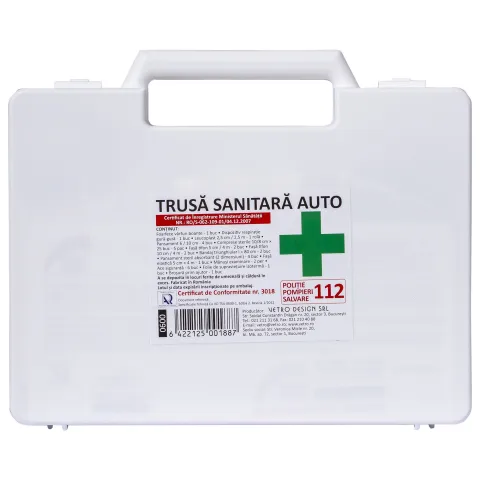
- The minimum contents are set by Ministry of Health Order 987/2007: 14 items, from scissors to the thermal blanket
- Driving without the kit is fined as a class II offense, meaning 4 or 5 fine points
- The law sets no validity for the kit as a whole: what counts is the expiry date of each component, and expired components can be replaced
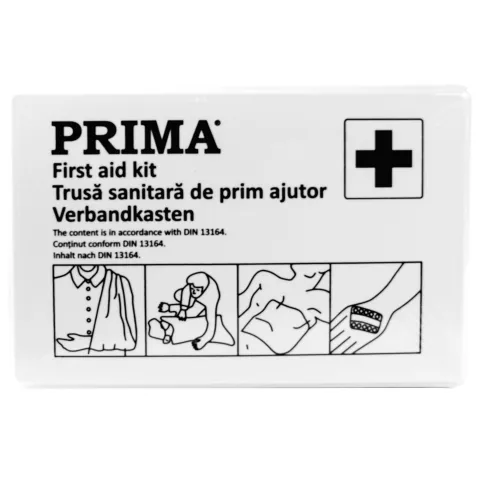
- A kit lawfully made or sold in another EU country, for example to DIN 13164, does not have to follow the Romanian list if it offers equivalent protection
14itemsin the minimum contents of the car first aid kit, approved by Ministry of Health Order 987/2007.
4–5fine pointsfor driving a vehicle without the kit, triangles and extinguisher: a class II offense.
0medicinesthe official list contains only instruments, medical supplies and miscellaneous items.
What the law says about the car first aid kit
The obligation comes from the Road Code. Article 8 of Government Emergency Ordinance 195/2002 on road traffic states that, in order to be driven on public roads, motor vehicles, except those in categories AM, A1, A2 and A, agricultural or forestry tractors and trams must be equipped with a first aid kit, two warning triangles and a fire extinguisher, all approved (the law uses the term "omologate").
The Road Code does not say what goes inside the kit. That task belongs to the Ministry of Health, which, under Article 125(e) of the same ordinance, "establishes and certifies the contents of first aid kits". The applicable act is Order 987/2007 of the Minister of Public Health approving the minimum contents of the car first aid kit, published in the Official Gazette no. 388 of 8 June 2007. The legislative portal records no amendment or repeal of it.
Who must carry a kit GEO 195/2002, Art. 8All motor vehicles except those in categories AM, A1, A2 and A, which include mopeds and motorcycles. The obligation also covers agricultural or forestry tractors and trams.
What else must be on board same articleTwo warning triangles and a fire extinguisher. The law requires all three to be approved.
Who sets the contents Order 987/2007The Ministry of Health. The order approves the minimum contents, the rules for the case and the label, and the user's right to replace expired components.
Who pays the fine GEO 195/2002, Art. 100The driver: the offense described by the law is driving a vehicle that is not equipped with an approved kit, triangles and extinguisher.
What fine you risk
Driving a motor vehicle, agricultural or forestry tractor or tram that is not equipped with an approved first aid kit, two warning triangles and a fire extinguisher is a class II offense (Article 100(1), point 13). Class II means 4 or 5 fine points (Article 98(4)), and one fine point is worth 5% of the guaranteed gross national minimum base wage (Article 98(2)). The amount in lei therefore changes whenever the minimum wage changes.
14Order 987/2007, annex
What the kit must contain: the official list
The annex to the order groups the minimum contents into three parts: instruments (the first two items), medical supplies (the next eight) and miscellaneous items (the last four). Where the order says "minimum", a larger size or quantity meets the requirement.
| Item | Size or characteristics | Quantity |
|---|
| Scissors | both tips blunt, with a blade that cuts heavy fabric (felt type) of at least 2 mm; 14–20 cm | 1 piece |
| Mouth-to-mouth resuscitation device | with a one-way valve or a filter | 1 piece |
| Adhesive tape (leucoplast) | at least 2.5 m × 2.5 cm | 1 roll |
| Adhesive plaster (quick dressing) | at least 6 × 10 cm | at least 4 pieces |
| Sterile gauze swab | at least 10 × 8 cm | at least 5 packs of at least 25 pieces each |
| Gauze bandage | 5 cm × 4 m and 10 cm × 4 m | at least 2 pieces of each size |
| Non-stretch triangular bandage | two sides of at least 80 cm | 2 pieces |
| Sterile absorbent dressing | at least two sizes | at least 4 pieces |
| Elastic bandage | 5 cm × 4 m | 1 piece |
| Disposable gloves | polyethylene or latex, medium size | 2 pairs |
| Safety pins | at least 4 cm | at least 6 pieces |
| Thermal survival blanket | 2.10 × 1.60 m | at least 1 piece |
| First aid instruction booklet | written according to European standards for lay first aid, authorized by the Ministry of Public Health's Commission for emergency and disaster medicine | 1 piece |
| List of the kit's contents | – | – |
The case and the label
The order also sets requirements for the case (Article 2). It must protect the contents from dust, moisture, fuel and oils with a firm closing system, and be sized so that the components stay intact. The label must show the product name, the manufacturer's name and address and, where applicable, those of the person responsible for placing the product on the market.
Kits from other EU countries and DIN 13164 kits
Under Article 4 of the order, the list in the annex does not apply to kits lawfully made or sold in another European Union member state, or lawfully made in a European Economic Area state, if they provide an equivalent level of protection. DIN 13164 is the German standard for first aid kits in motor vehicles; the current edition is DIN 13164:2022-02, which replaced the 2014 edition. A kit made to this standard falls under Article 4 when it is lawfully made or sold in another EU country and offers equivalent protection. Keep the contents list in the case: together with the label, it shows which standard the kit meets.
!Component expiry dates
How long the kit is valid
Neither the Road Code nor Order 987/2007 sets a validity period for the kit as a whole. The dates come from the components: sterile gauze swabs and dressings, plasters and gloves have an expiry date, and the kit is good until the earliest one. For the kits in our catalog, the product sheets state 48 months, printed on the packaging, for the kit with the contents of Order 987/2007 and a 2-year validity for the DIN 13164 kit.
The order states plainly what to do when they expire: the user may replace expired components with products that have the same characteristics and are lawfully placed on the market (Article 6). If the case is intact and closes properly, you do not need a new kit.
1Write down the dateWhen you buy the kit, note the earliest expiry date on the case.
2Check after useAny gauze swab, plaster or pair of gloves you use gets replaced the same week.
3Replace what expiresSwap expired components for products with the same characteristics and keep the case.
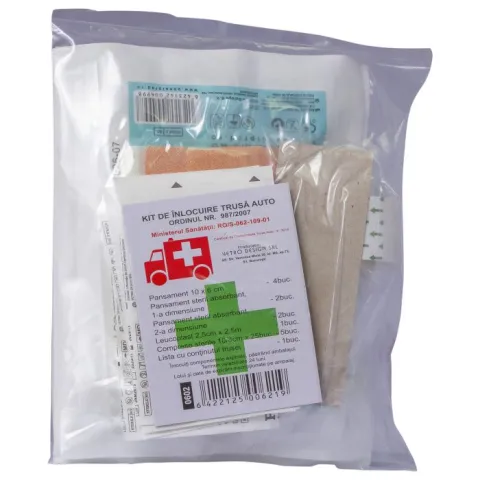
- The PRIMA car kit refill contains the consumables that expire: one 10 × 6 cm dressing, sterile absorbent dressings in two sizes (2 of each), a 2.5 cm × 2.5 m roll of tape and 5 packs of 10 × 8 cm sterile gauze swabs. After refilling, compare the kit with the official list and separately top up anything you used, such as plasters or gloves.
How to check the kit in five minutes
- Read the labelThe product name, the manufacturer and its address must be on the case.
- Compare the contents with the list insideThe contents list is itself one of the 14 mandatory items.
- Find the earliest expiry dateLook at the gauze swabs, the sterile dressings, the plasters and the gloves.
- Check the sterile packagingA torn, damp or opened pouch means a component to replace, even if it is in date.
- Close the case until it locksA firm closure protects the contents from dust, moisture, fuel and oils.
Where to keep the kit in the car
You should be able to take the kit out in seconds, not after unloading the boot: in the cabin, for example under a seat, or in the boot, secured in a side recess where luggage will not end up on top of it. Keep it away from spilled liquids.
Which kit to choose
| Situation | What to choose | Keep in mind |
|---|
| Private car | PRIMA car kit with the contents of Order 987/2007 | The contents on the product sheet match the list in the order; 48-month date printed on the packaging |
| You prefer the German standard | PRIMA DIN 13164 car kit | Contents follow the German standard (see Article 4 of the order); rigid plastic case, 25.5 × 16.6 × 8 cm, 2-year validity |
| Equipping a car from scratch | Pack with kit, extinguisher, vest and triangles | DIN 13164 kit, 1 kg extinguisher, reflective vest and two triangles |
| The kit is fine, but the consumables have expired | The refill kit | Replace only what expires, as Article 6 of the order allows |
| Company vehicles | One kit in every vehicle and scheduled refills | The obligation applies to every vehicle driven on public roads |
Car first aid kits and the refill kit
Common mistakes
- Keeping the kit under the luggageIn an accident you lose time exactly when it matters. Put it where you can grab it at once.
- Taking "just a bit of tape" from the kitMissing components are invisible from the outside. Whatever you use, put back the same week.
- Buying a new kit when the gauze expiresThe order allows expired components to be replaced with products of the same characteristics. The case stays.
- Leaving the kit with a cracked lidThe order requires a case sealed against dust, moisture, fuel and oils. A broken case no longer protects the contents.
- Using the office kit in the carThe workplace kit has a different contents list. In the car you need the car first aid kit.
Car kits, refill kits and the pack for the mandatory equipment
A kit with the contents of Order 987/2007, a DIN 13164 kit, a consumables refill and the pack with extinguisher, vest and triangles, in the Prima Shop catalog.
Frequently asked questions
Is a car first aid kit also mandatory for a motorcycle?
No. Article 8 of GEO 195/2002 exempts vehicles in categories AM, A1, A2 and A, which include mopeds and motorcycles. The obligation remains for other motor vehicles, agricultural or forestry tractors and trams.
What is the fine for not having a first aid kit in the car?
It is a class II offense (Article 100(1), point 13 of GEO 195/2002), meaning 4 or 5 fine points. One fine point is worth 5% of the gross national minimum base wage, so the amount changes with the minimum wage.
How long is a car first aid kit valid?
The law sets no period for the kit as a whole. What counts is the expiry dates of the components, especially the sterile gauze swabs and dressings, and the kit is good until the earliest one. The product sheets of the kits in our catalog state, for example, 48 months or 2 years.
Can I restock the car kit myself?
Yes. Article 6 of Order 987/2007 allows the user to replace expired components with products that have the same characteristics and are lawfully on the market. A refill kit does exactly that without changing the case.
Can I use a car kit bought in another European Union country?
Yes, if it is lawfully made or sold there and offers an equivalent level of protection: in that case the list in the annex does not apply to it (Article 4 of Order 987/2007). Kits made to the German standard DIN 13164, for example, can be in this situation.
Must the car kit contain medicines or disinfectant?
No. The minimum contents in Order 987/2007 cover only instruments, medical supplies and miscellaneous items, with no medicines, disinfectant solutions or alcohol.