When you draw venous blood, sample quality is decided before the tube ever reaches the laboratory: the right tube, the order in which you fill the tubes, the fill volume and the way you mix them. This guide brings together what the cap color means, which additive each tube contains, the order of draw set out in CLSI GP41 and in the European EFLM-COLABIOCLI recommendation, how to mix the tubes and what to check on the label before you order.
In short
- The cap color signals the additive, but the additive printed on the label is what counts.
- CLSI GP41 order: blood culture, citrate, serum (with or without clot activator and gel), heparin, EDTA, sodium fluoride with oxalate.
- Fill the tube to the mark; below 90% of the draw volume the blood-to-additive ratio is no longer right.
- Gentle inversions, no shaking: one right after filling and at least four more at the end, or as many as the manufacturer specifies.
- Needle, holder and tube work as one system; expired tubes lose vacuum.
What a vacutainer is and how the closed system works
In practices and laboratories, “vacutainer” has come to mean any evacuated tube for venous blood collection. The system has three parts: the double-ended needle, the holder that the needle is mounted in, and the tube. Once the vein is punctured, the holder end of the needle pierces the stopper and the vacuum draws a volume set by the manufacturer. The amount of additive in the tube is calculated for exactly that volume, so filling matters as much as choosing the tube.
The 2018 EFLM-COLABIOCLI recommendation treats the needle, holder and tube as one integral system: use components from the same manufacturer, which guarantees their compatibility, and never combine parts from different manufacturers. The same document notes that expired tubes have reduced vacuum, draw less blood than they should and give the wrong blood-to-additive ratio, and that temperature, humidity, altitude and light can change the draw volume and the stability of gels and additives.
Cap color and the additive inside
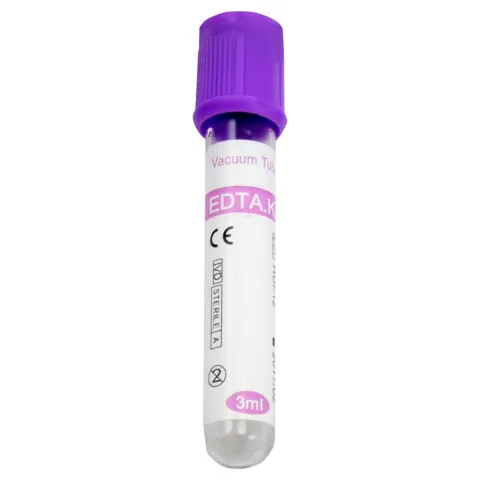
The cap color is a visual code for the additive. CLSI gives colors only as examples and lists several shades for the same additive: an EDTA tube, for instance, may have a lavender, pearl or pink closure. The PRIMA tubes in the catalog use the colors in the table below. The reliable source is still the label, which states the additive, its concentration and the volume.
| Cap | Additive | What you get | Typical use | Examples in the catalog |
|---|
| blue | sodium citrate | citrated plasma | coagulation tests | PRIMA coagulation tube, citrate 3.8%, 2 or 4.5 ml, glass |
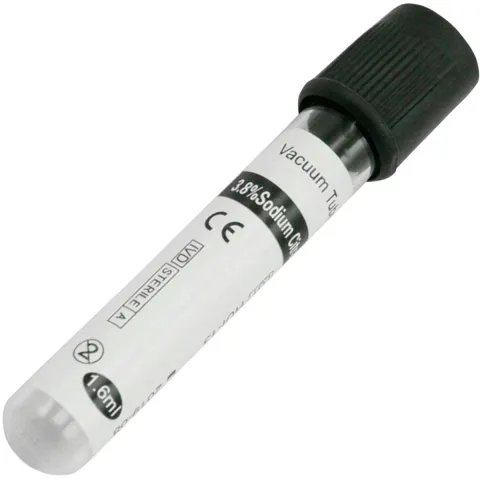
| black | sodium citrate, 1:4 ratio | whole blood | ESR | PRIMA ESR tube, 1.6 ml, glass |
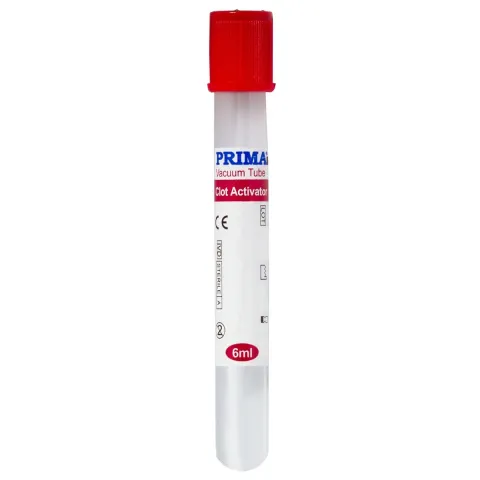
| red | no additive or clot activator | serum | biochemistry, immunology | 6 ml tube with activator (glass) or without additive (PET) |
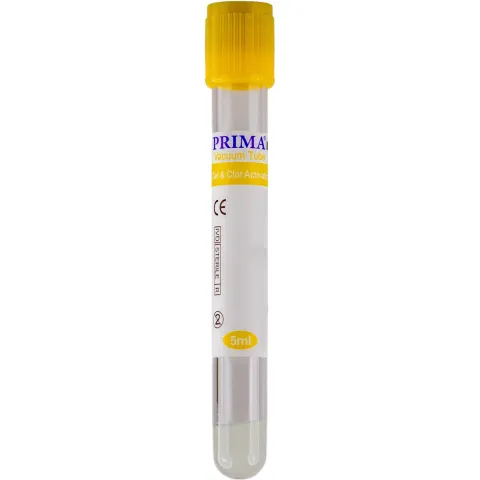
| yellow | clot activator and separator gel | serum separated from the clot by gel | biochemistry, immunology | 5 ml biochemistry tube with gel, plastic |
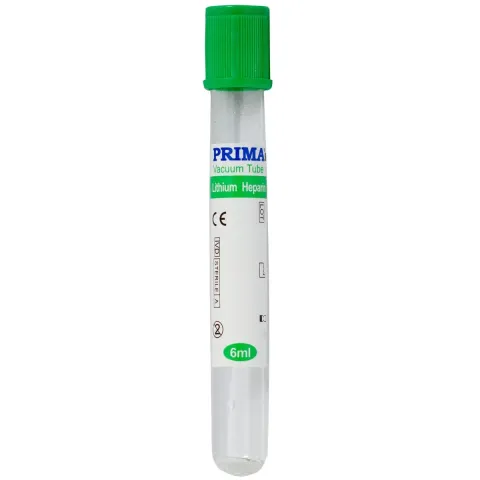
| green | heparin (lithium heparin in the catalog) | heparinized plasma | clinical chemistry on plasma | 6 ml glass tube; 0.5 ml microtainer |
| violet | EDTA (K3 EDTA in the catalog) | whole blood | hematology | 3 ml K3 EDTA hematology tube; 2 ml; 0.5 ml microtainer |
| gray | sodium fluoride and potassium oxalate | plasma | samples in which glycolysis must be stopped | not in the catalog |
Besides the activator, the yellow tube contains a gel that settles between serum and clot during centrifugation; for the order of draw, tubes with and without gel belong to the same serum group. The gray tube contains a glycolysis inhibitor, which stops the cells in the sample from consuming glucose.
PRIMA blood collection tubes by stopper color
PRIMA Coagulation Vacutainer Tubes, Blue Cap, Glass, 13x75mm, 100 pcs
from 48,39 lei
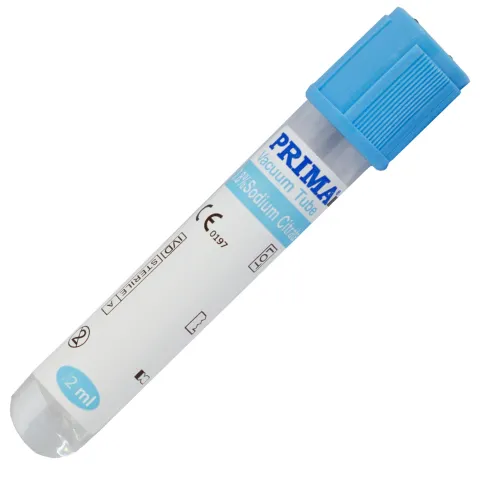
PRIMA Coagulation Vacutainer Tubes, Blue Cap, Glass, 13x75mm, 100 pcs
in stock
2 variante
4839Lei
excl. VAT: 39,99 Lei
ESR Vacutainer 1.6 ml, Black Cap, 3.8% Sodium Citrate, Glass, 8x120 mm, PRIMA, 100 pcs
ESR Vacutainer 1.6 ml, Black Cap, 3.8% Sodium Citrate, Glass, 8x120 mm, PRIMA, 100 pcs
in stock
6534Lei
excl. VAT: 54,00 Lei
PRIMA Biochemistry Vacutainer Tube 6 ml, Red Cap, Clot Activator, Glass, Sterile, 100 pcs
PRIMA Biochemistry Vacutainer Tube 6 ml, Red Cap, Clot Activator, Glass, Sterile, 100 pcs
in stock
5566Lei
excl. VAT: 46,00 Lei
PRIMA Vacutainer 5 ml, Yellow Cap, for Biochemistry, Clot Activator and Separator Gel, PE Plastic, 100 pcs
PRIMA Vacutainer 5 ml, Yellow Cap, for Biochemistry, Clot Activator and Separator Gel, PE Plastic, 100 pcs
in stock
7259Lei
excl. VAT: 59,99 Lei
Hematology Vacutainer 3 ml, Purple Cap, K3 EDTA, Capillary Blood Collection Tube, PRIMA, 100 pcs
Hematology Vacutainer 3 ml, Purple Cap, K3 EDTA, Capillary Blood Collection Tube, PRIMA, 100 pcs
in stock
5687Lei
excl. VAT: 47,00 Lei
Microtainers for capillary blood
For capillary sampling with a lancet there are 0.5 ml microtainers with the same color code: violet with K3 EDTA, green with lithium heparin and red with clot activator. The order-of-draw and mixing advice in this guide applies to venous collection; for capillary sampling, follow the laboratory’s protocol.
The order of draw under CLSI GP41
CLSI GP41, “Collection of Diagnostic Venous Blood Specimens”, sets the order in which tubes are filled so that the additive from one tube does not end up in the sample of the next. The order is the same whether you collect with a syringe, a tube holder or directly into evacuated tubes:
- Blood culture, tube or bottle.
- Sodium citrate, for coagulation (blue cap).
- Serum: tubes without additive, with clot activator or with gel (red, gold or yellow).
- Heparin, with or without gel (green).
- EDTA, with or without separator gel (violet).
- Sodium fluoride with potassium oxalate, a glycolysis inhibitor (gray).
The EFLM-COLABIOCLI recommendation uses the same sequence, with other tubes (for example those without additives) at the end, and asks for the order to be followed at every collection, without exception. Its reasoning: additive carry-over happens more often than expected, is hard to spot in the result, and following the order has no downside.
The ESR tube and tubes not on the list
The black ESR tube is not listed separately by CLSI. For tubes that are not listed, CLSI asks you to consider whether their additive could alter the result of the next tube. Place them as instructed by the tube manufacturer and by the laboratory that processes the sample.
When the coagulation tube is the first or only tube
- With a straight needle and holder, no discard tube is needed (EFLM).
- With a butterfly, meaning a winged needle with tubing, draw a discard tube first so the citrate tube is not underfilled (EFLM).
- Only blood cultures, glass non-additive serum tubes or plastic serum tubes without clot activator may be drawn before the citrate tube, because the clot activator in plastic tubes can interfere with coagulation testing (CLSI).
How full the tube should be and how to mix it
The blood-to-additive ratio is calculated for the nominal volume. EFLM asks for tubes to be filled up to the mark and strongly discourages tubes filled below 90% of the draw volume. In citrate tubes the ratio is fixed: the PRIMA ESR tube holds 0.4 ml of citrate for 1.6 ml of blood.
For mixing, EFLM recommends:
- One inversion right after filling, before the next tube. One inversion means turning the tube vertically through 180° and back.
- At least four more inversions at the end, after you have removed the needle and activated the safety mechanism, so five in total. A single tube is inverted five times straight away.
- No shaking: vigorous mixing can cause hemolysis, platelet activation or clots.
- Keep the tubes upright until processing.
If the manufacturer specifies a different number of inversions, follow its instructions. For the red PRIMA tube with clot activator, for example, the product sheet asks for 5–8 gentle inversions immediately after collection and gives a clotting time of 10 minutes.
Steps around the draw that affect the sample
- Identification: at least two identifiers, name and date of birth, checked against the test request and the tube label. If they do not match, the collection is postponed.
- Tourniquet: EFLM recommends drawing without a tourniquet when veins are clearly visible. If you use one, keep the total time under one minute, release it as soon as blood flows into the first tube and prefer single-use tourniquets.
- Disinfection: 70% ethyl alcohol or another suitable disinfectant, a single wipe, then let the site dry; before a blood culture, for at least 60 seconds.
- Gloves: EFLM suggests putting them on before the tourniquet, so that stasis stays under one minute, and changing them after every collection.
What to check on the label and the data sheet
- Additive and concentration: K3 EDTA, 3.8% sodium citrate, lithium heparin, clot activator, separator gel.
- Draw volume in ml and the fill mark on the tube.
- Size and material: 13 × 75 mm or 13 × 100 mm, glass or PET plastic. Check that the tubes fit the centrifuge and analyzer racks of the laboratory you work with.
- Expiry date and lot. Organize your stock so that tubes are used before they expire, as EFLM also requires.
- Storage conditions from the manufacturer’s sheet: temperature, humidity, light.
- Compatibility with the needles and holders you use, as declared on the product sheet.
- Legal status: Regulation (EU) 2017/746 treats specimen receptacles, evacuated or not, as in vitro diagnostic medical devices (IVD) and places them in class A. For those supplied sterile, the manufacturer goes through a notified body assessment limited to the aspects of sterility.
Needles and accessories for blood collection
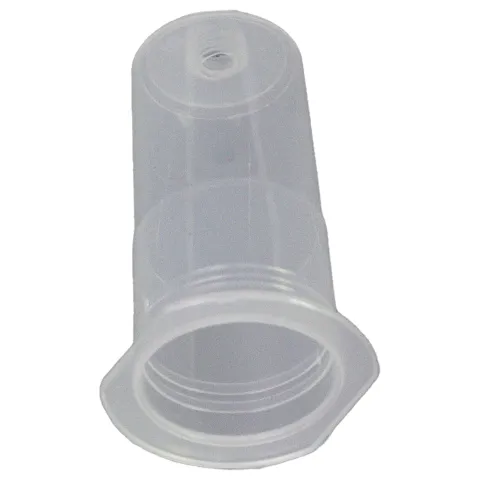
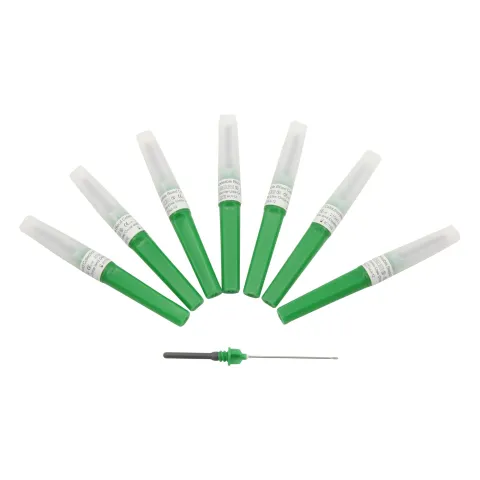
Besides tubes, venous collection needs vacutainer needles, a holder, a tourniquet, a disinfectant and a sharps container. PRIMA vacutainer needles come in 18G (pink, 1.2 × 38 mm), 21G (green) and 22G (black, 0.7 × 38 mm), sterile and single use, with a rubber sleeve and protective cap, 100 per box. The PRIMA holder is transparent and single use. For butterfly collection there are collection needles with a Luer Lock adapter and the butterfly-to-vacutainer adapter.
Holder and vacutainer needles
The needle color shows its gauge, not an additive, and follows a different code from the caps. All the tubes, needles and accessories in this guide are grouped in the blood collection category. For tests that need special tubes, such as blood cultures, ask the laboratory you work with for its list of accepted tubes.
Frequently asked questions
What does the cap color on a vacutainer mean?
The color indicates the additive. For the tubes in the catalog: blue – sodium citrate (coagulation), black – sodium citrate 1:4 (ESR), red – no additive or clot activator (serum), yellow – activator and separator gel, green – lithium heparin, violet – K3 EDTA (hematology). Gray tubes contain sodium fluoride and potassium oxalate. Colors are not identical across manufacturers, so check the additive printed on the label.
What is the correct order of draw for blood collection tubes?
Under CLSI GP41: blood culture, sodium citrate, serum tubes (with or without activator and gel), heparin, EDTA and, last, sodium fluoride with oxalate. The European EFLM-COLABIOCLI recommendation uses the same order and asks for it to be followed at every collection.
How many times should a vacutainer be inverted after collection?
EFLM recommends one gentle inversion immediately after filling and at least four more once collection is finished, five in total, without shaking. If the manufacturer gives a different number, follow the tube’s instructions.
Can expired collection tubes be used?
No. According to EFLM, expired tubes have reduced vacuum, draw less blood than the nominal volume and give the wrong blood-to-additive ratio; the additive may also deteriorate.
Can I combine needles and holders from another manufacturer with my tubes?
EFLM treats the needle, holder and tube as one system and recommends components from the same manufacturer, which guarantees their compatibility. Components from different manufacturers should not be combined.