We use cookies necessary for the site to work and, with your consent, for: preferences, statistics, relevant offers and maps.
Your preferenceswe remember your choices from one visit to the next
Un site mai bunwe see what works and what doesn't, without identifying you
Oferte potriviteads for products you're interested in, not random ones
Google Mapslocations and pickup points shown on the map
You can change your choice anytime from “Cookie settings", in the page footer. Cookie policy
Cookie settings
You choose what we store on your device. Strictly necessary cookies always stay active. All the details are in Cookie policy.
Strict necesare
The site does not work without them: they keep you logged in, keep your cart and the steps of a booking, and protect your forms. They cannot be turned off.
Always active
Ce folosim (5)
Sesiunea · noi
Recognizes you from one page to the next: the cart, your account, the steps of a booking. prima-shop-session · 2 hours from the last action
Form protection · noi
Prevents a form from being submitted on your behalf from another website. XSRF-TOKEN · 2 ore
Stay signed in · noi
Only if you choose to stay signed in on this device. remember_web_…, remember_bookora_… · 400 de zile
Your cookie choice · noi
Remembers what you chose here, so we don't ask you on every page. acord_cookie · 6 luni
Anti-bot protection · Cloudflare (Turnstile)
Checks, without image puzzles, that contact forms are not submitted by bots. Cloudflare's own technical storage · how long the review takes · their policy
Preferences
They remember your choices between visits, so you don't have to make them again each time.
What we use
Product display · noi
Products are shown as a list or a grid, as you last chose. ps_view · 1 an
Statistics
They show us, without identifying you, how many visitors we have, which pages are searched for and where people get stuck, during an order or a booking — so we can improve the site. Without consent, Google receives only anonymous signals, without cookies.
What we use
Google Analytics 4 · Google Ireland Ltd.
Visit and sales statistics: pages viewed, products, cart, orders. _ga, _ga_* · up to 2 years · their policy
Marketing
They help us find out which ads bring in orders and show you, on other sites, products you viewed with us. Without consent, we do not measure ads on your device and you do not receive personalized ads from us.
What we use
Google Ads (conversions and remarketing) · Google Ireland Ltd.
Links an order to the ad you came from and builds remarketing lists with the products you viewed. When you order, your e-mail and phone number are sent to Google only in encrypted (hashed) form, for conversion matching. _gcl_au, _gcl_aw, cookie-uri Google (de exemplu IDE) · up to 13 months, set by Google · their policy
Maps
Maps are provided by Google Maps. When they load, Google receives your IP address and may set its own cookies. Without consent, we only show you a link to the map or the list of locations.
What we use
Google Maps · Google Ireland Ltd.
Shows the map: the business location on BookOra, and in the store the point chosen when entering the address and the easybox lockers at checkout. cookie-uri Google (de exemplu NID) · up to 6 months, set by Google · their policy
Medical Waste in the Practice: What Romanian Order 1226/2012 Requires for Containers, Labels and Storage
23 October 2026The Prima Shop Team10 min read
Every injection, dressing or extraction leaves behind waste that the law does not let you throw in the ordinary bin. The rules look numerous, but they come down to a few steps done right every day: separate at the point of generation, use the right container, label it, store it only as long as allowed and hand it over to an authorized company.
This guide summarizes what Romanian Minister of Health Order 1226/2012, the act in force for waste from medical activities, requires: categories and codes, containers, the label, storage, hand-over and records. The text was checked on the Ministry of Justice legislative portal in October 2026: the order and its technical rules have not been amended since publication.
7 daysin the practicemaximum storage time for infectious waste, at a temperature constantly below 4 °C.
3/4of the volumemaximum filling level of a bag for infectious waste.
300 kgper yearbelow this amount of hazardous waste, a unit need not draw up a management plan, but it must follow the rules.
Who the order applies to
The order applies to all units carrying out medical activities, whatever their legal form: hospitals, clinics, medical and dental practices, laboratories. The technical rules also explicitly mention activities related to medical ones, such as beauty and body care practices, palliative care and home care, and set the duties of the person designated there to coordinate the collection, transport, treatment and disposal of their own waste (Article 68).
The basic rule is separation. Producers of medical waste must collect it separately by type and must not mix hazardous waste types with each other or with non-hazardous waste. If separation is not done, the whole quantity that hazardous waste got into is treated as hazardous waste (Article 12).
The management plan order, Art. 6–7
Each unit draws up its own medical waste management plan. Applying the order and having the plan are mandatory for the annual endorsement of the sanitary operating authorization.
The exception for small units order, Art. 7(7)
Units generating less than 300 kg of hazardous waste per year need not draw up the plan, but they follow the technical rules and report the quantities produced.
Waste categories and their codes
The rules use the codes of the waste list approved by Government Decision 856/2002. Codes marked with an asterisk are hazardous waste (Article 8).
Code
Category
Examples given in the order
18 01 01
Sharps that have not touched potentially infectious material
Needles, catheters, syringes with needles, IV cannulas, scalpel blades, broken glassware, single-use, unused or past their expiry date
18 01 03*
Infectious waste
Anything that has come into contact with blood or other body fluids: gloves, gauze swabs, dressings, tubes, infusion sets with tubing, surgical drapes, used laboratory materials; and contaminated sharps
18 01 02
Anatomical and pathological waste
Human tissue fragments and organs, biopsy material, blood containers and blood; all are considered infectious
18 01 04
Waste without special requirements
Uncontaminated clothing and linen, plaster casts, containers that held medicines other than cytotoxic and cytostatic ones
Amalgam capsules or residues, extracted teeth with amalgam fillings
Same needle, two codesAn unused needle past its expiry date has code 18 01 01. After an injection it becomes infectious waste, 18 01 03*. The order requires sharps from both categories to be collected separately from other waste, in the same rigid plastic container (Article 17).
Color code and pictograms
Yellow hazardous
Containers for hazardous medical waste are yellow or marked in yellow (Article 14).
Black non-hazardous
Non-hazardous waste goes into black bags labeled "Deșeuri nepericuloase" (non-hazardous waste); if none are available, into clear colorless bags (Article 30).
"Biohazard" infectious
The mandatory pictogram for infectious waste, including on the bins holding the bags (Articles 15–16).
Chemical pictograms 18 01 06*
Hazardous chemicals carry the pictograms for their properties: "Flammable", "Corrosive", "Toxic" and so on (Article 15).
R
Articles 13–30 of the rules
The right container for each category
Category
Container
What the order requires
Sharps
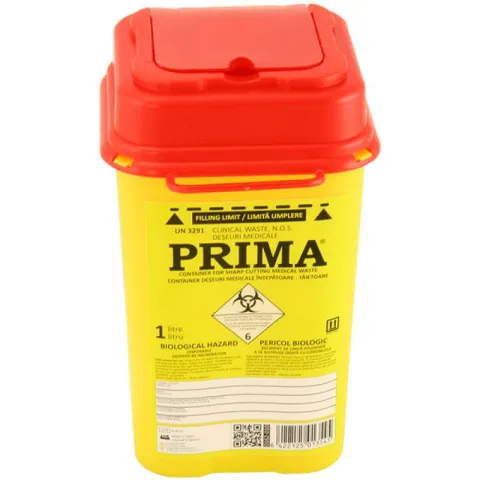
Rigid yellow plastic container with the "Biohazard" pictogram
A lid through which waste cannot be removed, openings for detaching needles and blades, temporary and final closure, a handle, leak-proof and stable on the treatment table; tested to SR 13481/2003 or other European standards
Infectious, non-sharp
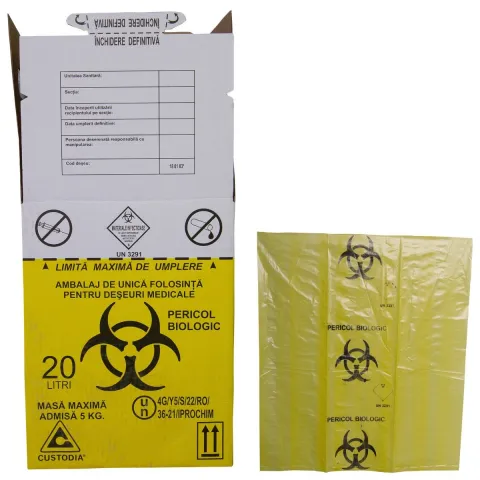
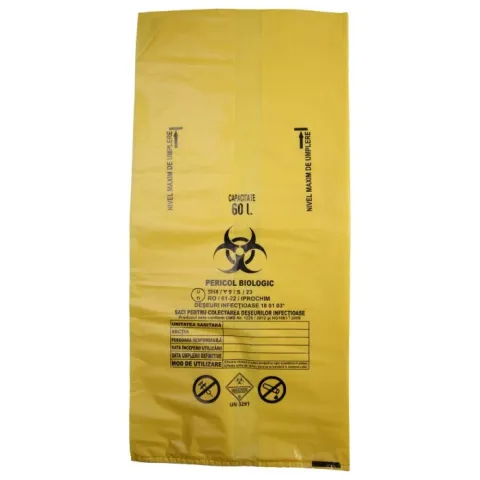
Cardboard box with a yellow bag inside, or a yellow bag
Polyethylene of 50–70 microns, single-use seals, continuous welds; the bag is filled to three quarters at most and, without a box, sits in a pedal bin with a lid or in a lidded bag holder
Anatomical and pathological
Rigid cardboard box with a bag, or a rigid plastic container with a sealed lid, marked yellow
Disposed of by incineration
Hazardous chemicals
Special containers marked with the hazard
At most 5 l for liquids or 5 kg for solids; the full outer packaging does not exceed 30 kg
Dental amalgam
Sealable containers
Collected by authorized companies for recovery
Non-hazardous
Black bags
Labeled "non-hazardous waste"
Rules that apply to every container
The container in direct contact with hazardous waste is single-use and is disposed of together with its contents (Article 13).
Packaging must have certification and test documents, a UN-standard marking and must comply with ADR, the European agreement concerning the international carriage of dangerous goods by road (Article 28).
If only needles go into the rigid container, syringes without needles may go with the other infectious waste (Article 19).
Placing unpackaged hazardous waste loose, in bulk, is prohibited (Article 21).
For sharps: the 1-liter yellow container, which its product sheet describes as ADR-certified, for the treatment tray, and the 5-liter version for the blood collection room or the dental surgery.
Boxes, bags and containers for hazardous waste are marked and labeled in Romanian with the same information (Articles 16, 18, 20 and 22).
1Hazardous medical wasteInfectious sharps waste · 18 01 03*sample label
2Pictogram "Biohazard"
3Capacity: 5 l
4Instructions for use: close permanently at the fill line
5Maximum fill line marked on the container
6In use from: 00.00.0000
7Unit and department: Dental practice, room 2
8Person responsible for handling: full name
9Filled and closed on: 00.00.0000
10UN marking to ADR
Type of waste collectedThe category and, usefully, its code.
Pictogram"Biohazard" for infectious waste.
CapacityIn liters or kilograms.
Instructions for useHow the container is used and closed.
Fill lineThe maximum level up to which waste goes in.
Start dateThe day the container went into use.
Unit and departmentWho used the container.
Person responsibleWho handles it.
Final fill dateThe storage time is counted from it.
UN markingTo United Nations standards, for ADR transport.
How long and where to keep the waste
7Medical practicesInfectious waste 18 01 03* is stored for at most 7 days, at a temperature constantly below 4 °C (Article 34(2)).
48Other unitsAt most 48 hours; up to 7 days only in a space cooled below 4 °C with automatic temperature monitoring and recording.
24Transport and disposalTransport and final disposal of infectious waste take no longer than 24 hours (Article 34(4)).
!Restricted accessUnauthorised people have no access, and abandoning or uncontrolled disposal is prohibited (Article 31).
Every healthcare unit must have a central temporary storage area, with a locked compartment for hazardous waste and one for non-hazardous waste (Article 32). Cardboard boxes are kept on dry surfaces (Article 16).
Hand-over, records and training
A contract with an authorized operator. Hazardous and non-hazardous waste is handed over under contract to authorized operators, and transport is also done by authorized operators (Article 38).
Records by category. A designated person keeps records of waste by type and fills in the legal forms (Article 51); the unit also prepares an annual report (Article 52).
Training. Staff are trained when hired, when changing jobs, when new equipment or technologies are introduced and when irregularities are found (Article 55).
Common mistakes
Throwing bloody gauze into household wasteAny material contaminated with blood or body fluids is infectious waste, 18 01 03*.
Filling the yellow bag to the topA bag is filled to three quarters at most, so that it can be closed securely.
Putting needles in the cardboard boxSharps go only into a rigid, puncture-resistant container.
Mixing wasteA mix that hazardous waste got into is treated entirely as hazardous.
Leaving the label blankWithout the start and fill dates you cannot prove the storage time.
Keeping waste longer than 7 daysOr without refrigeration: the rule for practices requires both limits.
Containers, boxes and bags for medical waste
Sharps containers, boxes with yellow bags, Biohazard bags and boxes for anatomical and pathological waste, in the infectious waste category of the Prima Shop catalog.
Do syringes without needles also go into the sharps container?
Not necessarily. If only the needles are collected in the rigid container, syringes without needles may be collected together with the other infectious waste, in the yellow box or bag (Article 19 of the rules approved by Order 1226/2012).
How long can infectious waste be kept in a practice?
For at most 7 days, provided the temperature is constantly below 4 °C (Article 34(2)). For other units the limit is 48 hours, except in spaces cooled below 4 °C with automatic temperature monitoring, where it is 7 days.
Does a small practice need a waste management plan?
Units generating less than 300 kg of hazardous waste per year are exempt from their own plan, but they must follow the technical rules and report the quantities and how the waste was managed (Article 7(7) of the order).
Are used gloves and gauze swabs infectious waste?
Yes, if they have come into contact with blood or other body fluids. The order lists them explicitly under code 18 01 03*, together with dressings, tubes and other contaminated single-use materials.
Do the rules also apply to beauty salons?
The rules list beauty and body care practices among activities related to medical ones and set the duties of the person designated there: coordinating and being responsible for the collection, transport, treatment and disposal of their own waste (Article 68).
Can I empty and reuse a sharps container?
No. The container in direct contact with hazardous waste is single-use and is disposed of together with its contents (Article 13), and the final closure system prevents it from being reopened.
Spirtul medicinal, apa oxigenată și soluțiile cu iod au roluri diferite. Afli ce înseamnă denumirile, unde folosești fiecare produs, ce este apa oxigenată 12% și cum le păstrezi în siguranță.
The difference between disinfection and sterilization, which instruments must be sterilized, the B, N and S cycles of EN 13060, dry heat sterilizers, pouches, indicators and how long instruments stay sterile.
What Romania's 2024 salon hygiene norms (Order 1,648/2024) require: single-use items, disinfection levels, sterilization, the 24-hour rule, the sterilization log, waste and a supplies checklist.