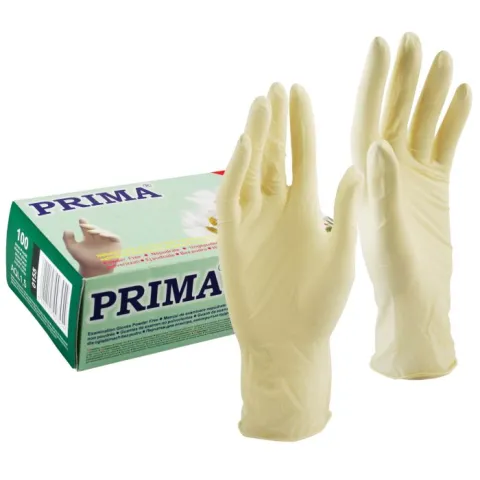
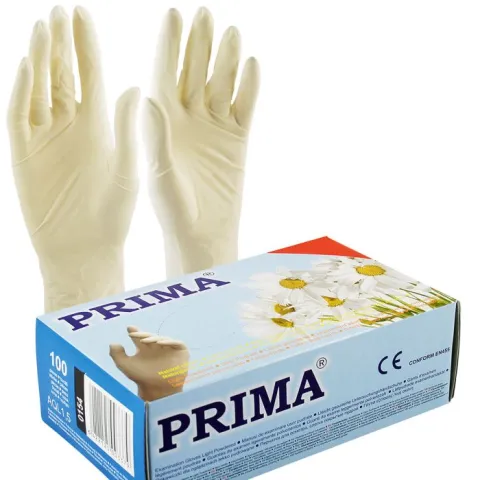
Examination gloves are the consumable a practice uses most often and, perhaps for that very reason, the one most often chosen out of habit. You feel the difference between a suitable pair and an unsuitable one every day: the sensitivity at your fingertips, irritated hands at the end of the day, a glove that tears right in the middle of a procedure, or a patient who is allergic to latex.
The guide below brings together everything that matters: the real differences between latex, nitrile and vinyl, what the markings on the box mean (EN 455, AQL, EN ISO 374), how to choose your size, when to change gloves and how to remove them without contaminating yourself. For each type, you will find the right products from the Prima Shop catalog.
Latex, nitrile or vinyl: a quick comparison
| Criterion | Latex | Nitrile | Vinyl |
|---|
| Material | Natural rubber | Synthetic rubber | PVC (polyvinyl chloride) |
| Fit and elasticity | very good | very good | loose fit |
| Tactile sensitivity | the best | very good | moderate |
| Puncture resistance | good | high | low |
| Chemical resistance | moderate | good, to many substances | limited |
| Allergies | contains latex proteins | free of latex proteins | free of latex proteins |
| Suitable for | Fine procedures, if there are no latex allergies | Most procedures, dentistry, sample collection, disinfection | Short tasks with low biological risk |
NThe most widely used choice
Nitrile gloves
Nitrile is a synthetic rubber. It does not contain the natural latex proteins that cause immediate-type allergies, it resists punctures and many chemicals well, and its fit is close to that of latex. When punctured, it tears visibly, so you can easily spot the defect. That is why it has become the default choice in dentistry, in treatments and wherever disinfectants are used.
- Abena Classic gloves are powder-free and latex-free, with a thickness of 0.08 (±0.02) mm and a minimum length of 240 mm. They are a Class I medical device under Regulation (EU) 2017/745, available in sizes S to XL.
- PRIMA, blue nitrile gloves are powder-free, non-sterile and ambidextrous, in sizes XS to XL.
- Abena Excellent gloves are made of antimicrobial nitrile, 0.07 mm thick. They are dual-certified: EN 455 and Category III personal protective equipment, tested to EN ISO 374-1 Type B (KPT) and EN ISO 374-5 "VIRUS".
- For other preferences: black nitrile or pink nitrile, both powder-free.
Nitrile examination gloves
from 27,35 lei
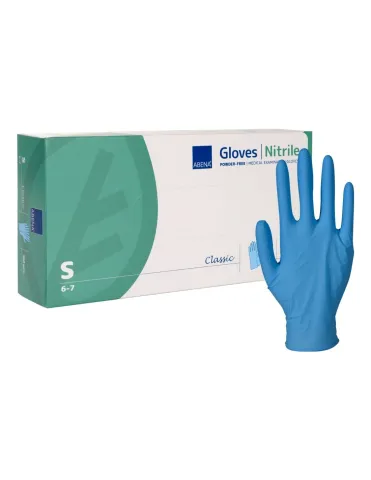
Abena Classic - Nitrile Examination Gloves - Blue - 100 pcs
in stock
4 variante
2739Lei
excl. VAT: 22,64 Lei
Promoted i
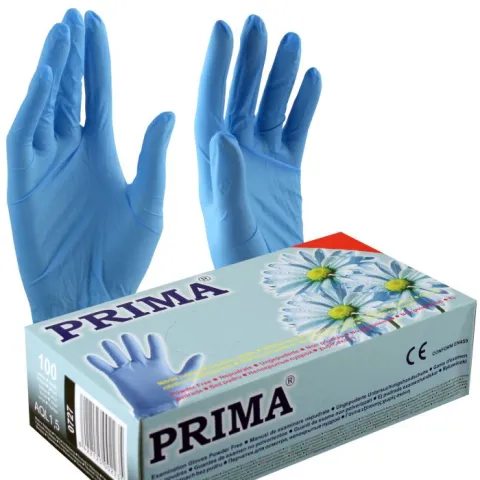
PRIMA Blue Nitrile Examination Gloves, Powder-Free, Sizes S-XL, 100 pcs
in stock
5 variante
2965Lei
excl. VAT: 24,50 Lei
from 75,60 lei
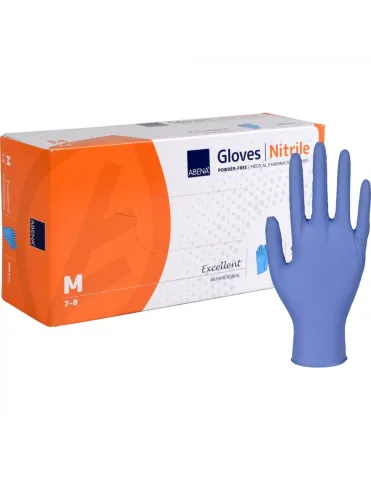
Abena Excellent - Antimicrobial Nitrile Examination Gloves - Blue
in stock
3 variante
8334Lei
excl. VAT: 68,88 Lei
LMaximum sensitivity
Latex gloves
Natural latex has the best elasticity and tactile sensitivity, and the glove feels like a second skin. The drawback is allergy: latex proteins can cause allergic reactions, sometimes severe, in both staff and patients. Before choosing latex, ask patients about allergies and keep a box of nitrile gloves on hand for them.
Powdered or powder-free?Powder helps the glove slide onto the hand, but it can irritate the skin, leave residue on instruments and materials and, with latex, carry allergenic proteins into the air. Powder-free gloves are preferred in medical settings.
Latex examination gloves
PRIMA Powder-Free Latex Protective Gloves, White, Sizes XS-XL, 100 pcs
in stock
5 variante
3629Lei
excl. VAT: 29,99 Lei
PRIMA White Latex Examination Gloves, Lightly Powdered, Sizes XS-XL, 100 pcs
in stock
5 variante
3266Lei
excl. VAT: 26,99 Lei
VFor short tasks
Vinyl gloves
Vinyl (PVC) is the cheapest material and contains no latex, but it is less elastic, fits more loosely on the hand and is less resistant to punctures and stress. These gloves are suitable for short, low-biological-risk activities: packing, food handling, administrative tasks. For procedures with a risk of contact with blood or fluids, choose nitrile or latex.
What about sterile surgical gloves?
Examination gloves are non-sterile. Surgical and invasive procedures call for sterile surgical gloves, packed in individual pairs, anatomically shaped for the left and right hand. PRIMA sterile surgical gloves are made of natural latex, powder-free, ethylene oxide sterilized, with textured fingertips, in sizes 6 to 8.5.
What the markings on the box mean
EN 455 medical glovesThe series of standards for single-use medical gloves: freedom from holes (part 1), physical properties (part 2), biological evaluation (part 3) and shelf life (part 4).
AQL batch qualityThe acceptable quality level in the leak test. The lower the number, the fewer defective gloves in the batch. For medical gloves, EN 455-1 requires an AQL of no more than 1.5.
EN ISO 374-1 chemicalsProtection against chemicals. Type A, B or C shows how many substances from the standard's list were tested and how long the glove resists them; the letters (for example K, P, T) say which ones: K for sodium hydroxide, P for hydrogen peroxide, T for formaldehyde.
EN ISO 374-5 "VIRUS" microorganismsThe glove protects against bacteria and fungi; the "VIRUS" label appears only if it has also passed the viral penetration test.
MDR or PPE legal classificationExamination gloves are medical devices (Regulation (EU) 2017/745). Those that protect the user, for example against chemicals, are personal protective equipment (Regulation (EU) 2016/425). Some models carry both classifications.
Sterile, thickness, length the details that matter"Non-sterile" is normal for examination. Greater thickness (in mm) means more durability but less sensitivity. A longer cuff covers the wrist better.
How to choose your size
A glove that is too small tires the hand and tears more easily; one that is too large wrinkles at the fingertips, reduces sensitivity and snags. To find the right size:
- Measure your palm circumferenceUsing a tailor's tape, around the width of the palm, below the knuckles, excluding the thumb, on your dominant hand.
- Compare with the manufacturer's chartXS–XL sizes are not identical from one manufacturer to another. For surgical gloves, the numeric size (6; 6.5; 7…) roughly corresponds to the palm circumference in inches: size 7 means about 17.8 cm.
- Try them on before a large orderThe glove should lie smooth on the fingers, without wrinkles, and should not squeeze at the wrist. If you are between two sizes, try both and keep the one you can work in for an hour without tiring.
When to change gloves and how to remove them correctly
Gloves do not replace hand hygiene. Disinfect your hands before putting them on and after taking them off, because microorganisms can pass through invisible micro-perforations or reach the skin during removal.
Always change gloves
- Between two patients, without exception.
- When the glove is torn, punctured or visibly soiled.
- When moving from a contaminated area to a clean one, even on the same patient.
- After touching surfaces outside the work area: phone, door handle, keyboard.
- Grasp the outside of the first glove at the wristWith your hand still gloved, take hold of the glove on the other hand on the outside, at the cuff.
- Pull it toward the fingers, turning it inside outThe contaminated side ends up inside. Hold it in the palm of the still-gloved hand.
- Slide your fingers under the cuff of the second gloveWith your bare hand, touch only the clean inside of the remaining glove.
- Remove it inside out, over the first oneThe two gloves end up one inside the other, with the outside turned in.
- Discard them and disinfect your handsIn the appropriate waste container, then perform hand hygiene.
For hand hygiene, before and after gloves
from 5,63 lei
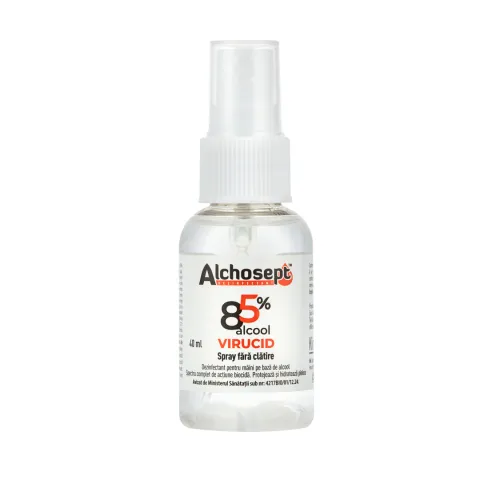
Alchosept Professional Hand and Skin Disinfectant with 85% Alcohol
in stock
11 variante
563Lei
excl. VAT: 4,65 Lei
from 45,00 lei
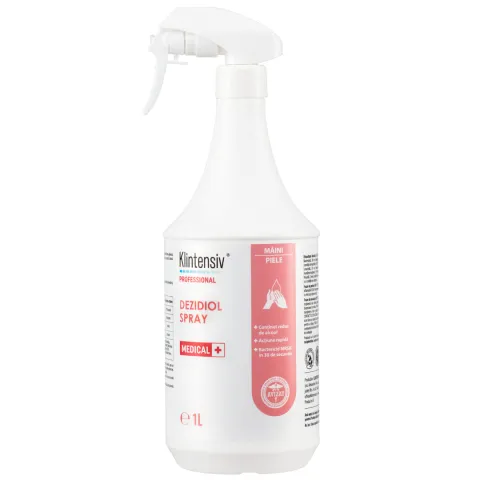
Dezidiol Spray Hand and Skin Disinfectant with Two Alcohols and Chlorhexidine
in stock
3 variante
4500Lei
excl. VAT: 37,19 Lei
Common mistakes
- Using the same pair for two patientsExamination gloves are single-use: change them between patients.
- Washing or disinfecting gloves to reuse themThe material degrades and micro-perforations form that you cannot see.
- Using examination gloves with concentrated disinfectantsFor chemicals, choose gloves tested to EN ISO 374-1 for that specific substance, or chemical protection gloves.
- Wearing rings or long nailsThey tear gloves from the inside and trap microorganisms under the glove.
- Storing boxes in the sun or near a radiatorHeat, light and ozone age the material. Store them in a cool, dry place and check the expiration date.
- Putting gloves on still-damp handsAfter using disinfectant, let your hands dry completely: otherwise the glove is harder to put on and the skin becomes irritated.
Which gloves for which situation
| Situation | What to choose |
|---|
| Consultation and examination | Non-sterile nitrile or latex examination gloves, powder-free |
| Dentistry, treatments, sample collection | Powder-free nitrile; latex only if there are no allergies |
| Surgical and invasive procedures | Sterile surgical gloves, by size |
| Handling disinfectants | Nitrile tested to EN ISO 374-1 for the substances used |
| Cleaning and restrooms | Reusable household gloves, for example nitrile with cotton flock lining |
| Short tasks with low biological risk | Vinyl or polyethylene gloves |
How many boxes you need per month
- Patients per day × 2 gloves × working days = minimum consumption. With 20 patients a day and 22 working days, 20 × 2 × 22 = 880 gloves, i.e. 9 boxes of 100.
- Add a reserve for changes during the same procedure and for cleaning, and keep stock of every size used by the team.
Gloves for the whole practice, by size, delivered by Prima Shop
Nitrile and latex examination gloves, sterile surgical gloves and household gloves, with company invoicing and stock in every size.
Frequently asked questions
I'm allergic to latex. Can I wear nitrile gloves?
Nitrile gloves do not contain natural latex proteins, so they are the usual alternative for people with latex allergy. However, some people react to the additives used in manufacturing, in both latex and nitrile, with contact dermatitis. If irritation occurs, talk to a dermatologist or allergist.
Do antimicrobial gloves mean I no longer need to disinfect my hands?
No. Hand hygiene before and after wearing gloves remains mandatory, whatever the type of glove.
What color should I choose?
Color does not change the protection. Blue and black make contamination and blood more visible. Black is also preferred in tattooing and veterinary medicine, and different colors help separate gloves by area or by person.
How long can gloves be stored?
Until the expiration date on the box, if kept in the original packaging, away from sunlight, heat and moisture.
Can I use examination gloves for cleaning?
For a quick wipe-down, yes. For general cleaning and restrooms, reusable household gloves are more durable and more economical, and for concentrated disinfectants, choose gloves tested against those substances.