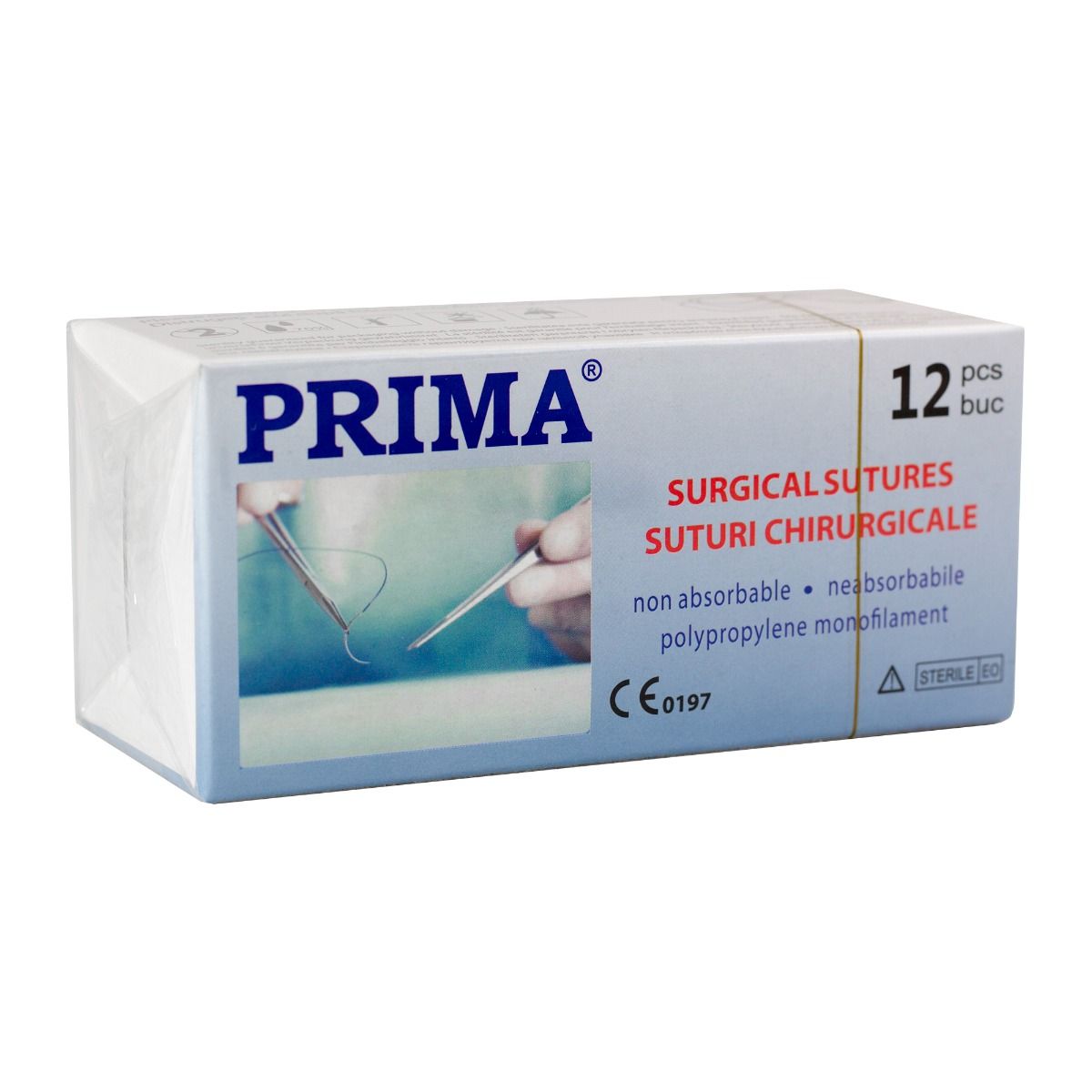

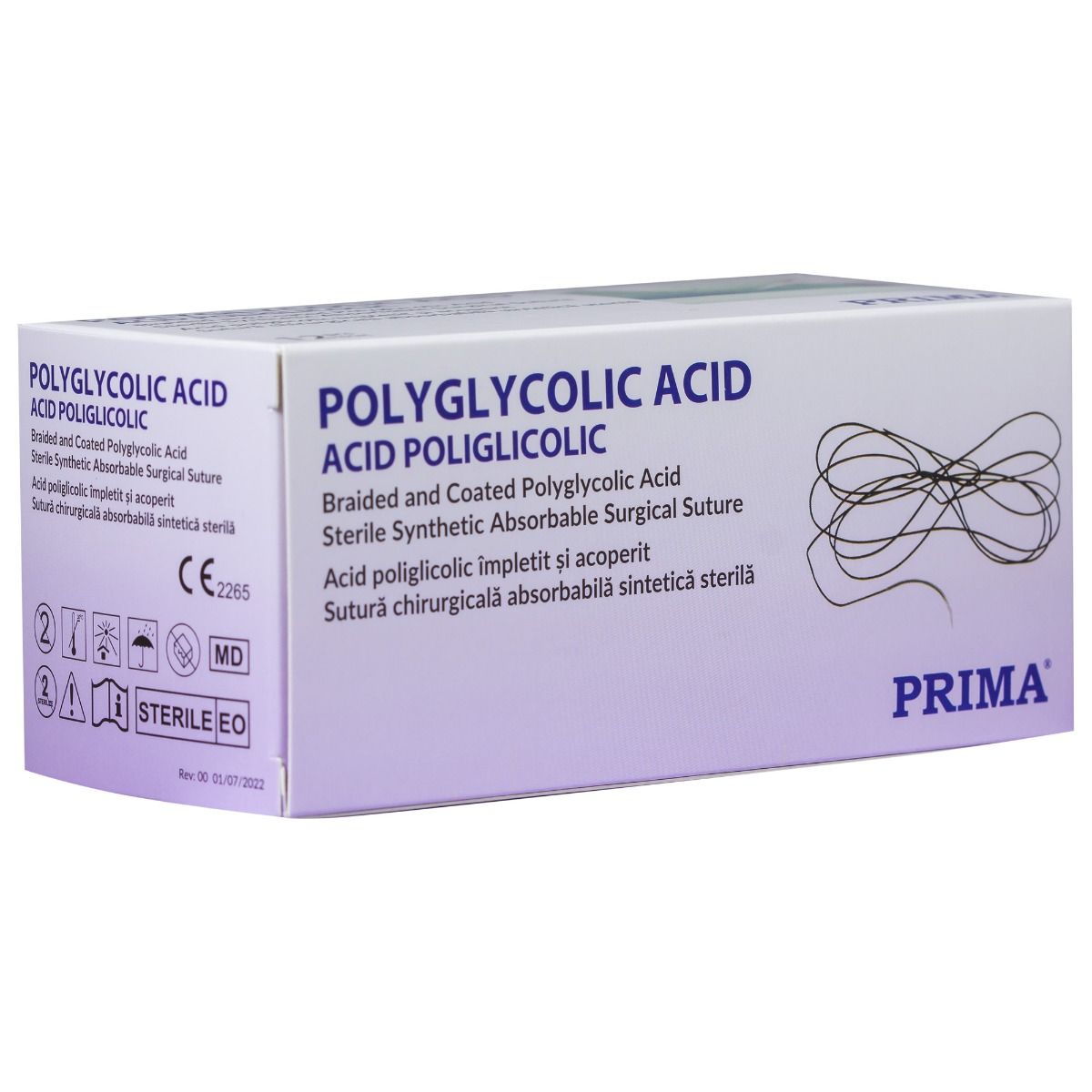
PRIMA Polyglycolic Acid Surgical Suture 75 cm, 3/8 Round Needle 19 mm, USP 3/0
- Tax invoice for every order
- 14-day free return right
- 2-year warranty for individuals, 12 months for companies
Product details
Enhance your surgical procedures with the PRIMA polyglycolic acid surgical suture with violet thread, featuring a length of 75 cm and a 3/8 circle atraumatic round needle 19 mm long, USP 3/0 diameter, available in packs of 12 pcs. This high-quality product is built to meet your surgical needs efficiently and safely.
Suture sizes are usually indicated using the USP (United States Pharmacopeia) system. This numbering system can be a little confusing, but it centers around the "0" suture. Suture sizes increase from USP size 0 ("zero") to size 1, commonly called "number 1," to USP size 2 ("number 2") and upward.
Polyglycolic acid suture (polyglycolic acid) is a synthetic, sterile, braided multifilament absorbable surgical suture prepared from 100% glycolide homopolymers. POLYGLYCOLIC ACID suture is dyed with D&C Violet No. 2 (in accordance with US Code of Federal Regulations). POLYGLYCOLIC ACID suture is also available undyed. For additional lubrication, smooth passage through tissue and easy knot tying, POLYGLYCOLIC ACID suture is coated with a mixture of polycaprolactone and calcium stearate. POLYGLYCOLIC ACID suture has been found to be non-antigenic and non-pyrogenic, and it elicits only a mild tissue reaction during the absorption process. The composition of the dyed polyglycolic acid suture is 96.1% - 99.2% polyglycolic acid, 0.4% - 2.2% polycaprolactone, 0.2% - 1.5% calcium stearate and < 0.2% D&C Violet No. 2. The composition of the undyed polyglycolic acid suture is 96.3% - 99.4% polyglycolic acid, 0.4% - 2.2% polycaprolactone and 0.2% - 1.5% calcium stearate. POLYGLYCOLIC ACID sutures comply with the requirements established by the European Pharmacopoeia (E.P) for sterile synthetic absorbable braided sutures and by the United States Pharmacopeia (U.S. P) for absorbable surgical suture (synthetic).
INTENDED USE
Polyglycolic acid suture is intended for use in general soft tissue approximation and/or ligation, including use in plastic and ophthalmic procedures, but not for use in cardiovascular and neurological tissues.
INDICATIONS
Indicated in surgical procedures where a combination of absorbable suture and short-term support is required for wound closure, soft tissue approximation and/or ligation.
CONTRAINDICATIONS
Polyglycolic acid suture, being absorbable, should not be used where extended tissue approximation is required.
USERS
Trained and registered healthcare professionals only.
INTENDED PATIENT POPULATION
This suture can be used in patients regardless of age and sex, in accordance with the intended use, indications and contraindications.
PERFORMANCE
After implantation, polyglycolic acid suture elicits a mild initial inflammatory reaction in tissues and is eventually replaced by an ingrowth of fibrous connective tissue. Polyglycolic acid suture, being absorbable in nature, is absorbed in tissues by hydrolysis, during which the polyglycolic acid polymer is degraded into glycolic acid, which is eventually absorbed and metabolized in the body. This absorption process initially results in a progressive loss of tensile strength, followed by a loss of mass. Implantation studies in rats indicate that, following implantation, the approximate percentage of original strength remaining for polyglycolic acid suture is 82% at 14 days, 56% at 21 days and 20% at 28 days, and complete absorption of the suture essentially occurs in about 90 days.
APPLICATION
The suture should be selected and implanted according to the patient's condition, surgical experience, surgical technique and wound size.
WARNINGS
- This suture is intended for use by a qualified and registered healthcare professional.
- Users should be familiar with surgical procedures and suturing techniques involving absorbable sutures before using polyglycolic acid suture for wound closure, as the risk of wound dehiscence may vary with the site of application and the suture material used. Users should consider in vivo performance when selecting a suture type.
- Users should exercise professional judgment when determining the appropriate suture size, based on the specific indication, wound size, preferred surgical technique, and the patient's condition and history.
- Use of this type of suture may be inappropriate in elderly, malnourished or debilitated patients, or in patients suffering from conditions that may delay wound healing.
- As with any foreign body, prolonged contact of this suture with salt solutions, such as those found in the urinary or biliary tract, may result in calculus formation.
- As an absorbable suture, it may act transiently as a foreign body and, as with any foreign body, the presence of bacterial contamination may enhance bacterial infectivity. Therefore, acceptable surgical practice should be followed with respect to drainage and closure of infected or contaminated wounds.
- Wound dehiscence may occur when the suture fails to provide adequate wound support in the closure of sites where expansion, stretching or distension occurs. Therefore, the user should consider the use of additional non-absorbable sutures in the closure of sites that may undergo expansion, stretching or distension or that may require additional support.
- In certain circumstances, especially in orthopedic procedures, immobilization by external support may be used at the user's discretion.
- It should be considered that when absorbable sutures are used in tissues with poor blood supply, suture extrusion and delayed absorption may occur.
- Conjunctival, cuticular and vaginal epithelial sutures remaining in place for extended periods may be associated with localized irritation and should be cut or removed as indicated.
- Subcuticular sutures should be placed as deeply as possible to minimize the erythema and induration normally associated with the absorption process.
PRECAUTIONS
Care should be taken to avoid damage when handling surgical needles. Grasp the needle in an area one-third (1/3) to one-half (1/2) of the distance from the attachment end to the point. Grasping in the point area could impair penetration performance and cause needle breakage. Grasping at the butt or attachment end could cause bending or breakage. Reshaping needles may cause them to lose strength and make them less resistant to bending and breaking. Broken needles may result in extended or additional surgery or residual foreign bodies.
- Users should exercise caution when handling surgical needles to avoid inadvertent needlestick injury. Discard used needles in the containers
Specifications
| Product code | PS-1840-RA-3-8-19-3-0 |
|---|---|
| Cantitate Bax | 50 |
Promoted products
We also recommend


Reviews (0 reviews)
There are no reviews for this product yet.
Customer questions and answers
There are no questions for this product yet.
Useful links:
Your browsing history
clear browsing history