The European Society of Hypertension (ESH) guidelines on blood pressure measurement, published in 2021, note that of the more than 4,000 blood pressure monitors on the world market, fewer than 10% have passed an established validation protocol. For a practice, validation is therefore the first selection criterion, ahead of memory or connectivity. This guide covers the types of blood pressure monitors, how to check a model’s validation, cuff selection and the ESH measurement rules, then thermometer types and what to check on each device’s data sheet.
In short
- Choose a clinically validated upper-arm monitor and check the exact model in an independent list such as STRIDE BP.
- The current validation protocol is the AAMI/ESH/ISO Universal Standard, ISO 81060-2:2018.
- Choose the cuff by arm circumference: one that is too small overestimates blood pressure, one that is too large underestimates it.
- Aneroid monitors need calibration at least once a year; mercury devices may no longer be manufactured in or imported into the EU since 31 December 2020.
- For thermometers, compare the type (contact, ear, forehead), measuring time, range and declared accuracy.
Types of blood pressure monitors
Automatic upper-arm monitors
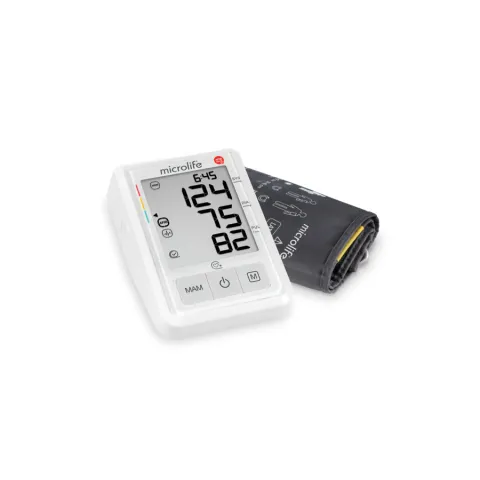
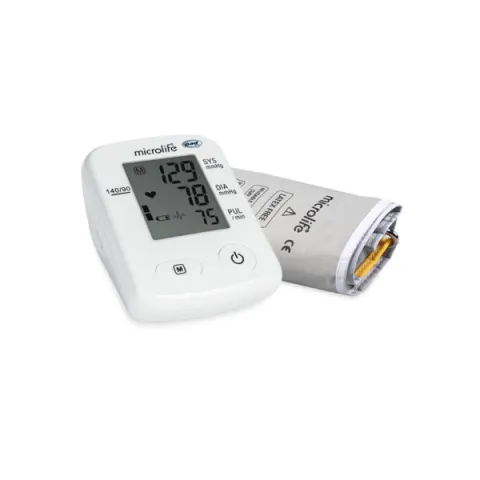
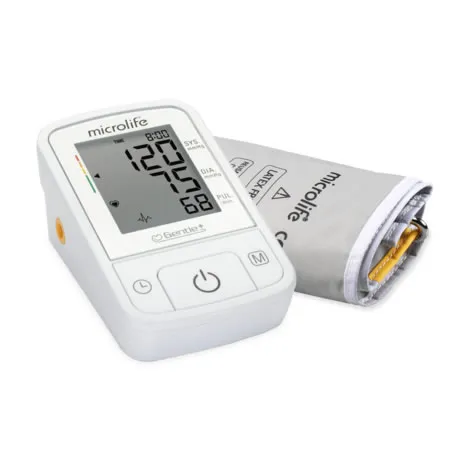
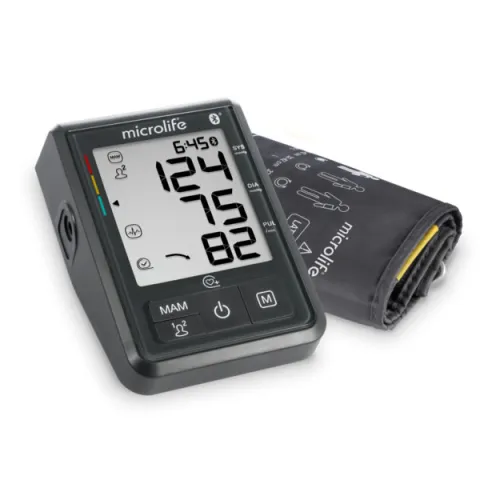
Electronic monitors inflate the cuff themselves and display the readings. ESH notes that they are used almost exclusively for home and ambulatory monitoring and increasingly in the office. The catalog includes, for example, the Microlife BP B1 Classic, B2 Basic, BP B3 AFIB, BP B3 BT, BP B6 Bluetooth Connect AFIB and the PRIMA electronic monitor with 120 memories.
The AFIB function on Microlife models flags an irregular pulse suggestive of atrial fibrillation. The BP B3 AFIB product sheet states that the diagnosis is confirmed by a doctor with an ECG, and ESH requires devices with additional features, such as atrial fibrillation detection, to be validated for those functions as well.
Professional office monitors
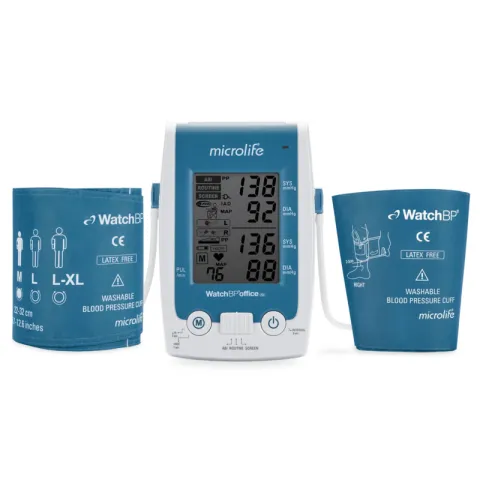
The Microlife WatchBP Office ABI measures automatically on both arms, calculates the ankle–brachial index (ABI) and the inter-arm difference, flags possible atrial fibrillation and takes three successive readings, displaying their average. Measuring both arms matches the ESH recommendation for the first visit, and the guidelines note that some professional devices can measure both arms simultaneously.
Aneroid monitors with a stethoscope
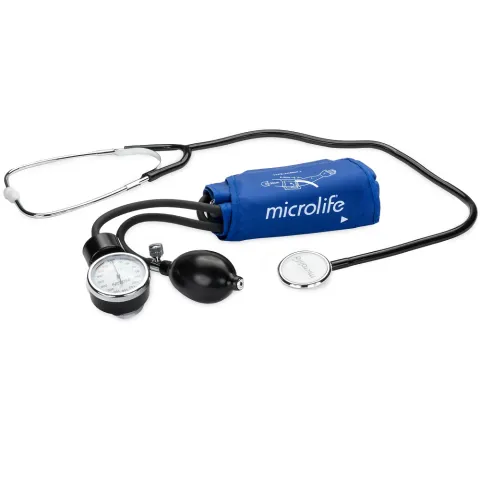
Aneroid (mechanical) monitors are used with the auscultatory method and a stethoscope. The Microlife AG1-20 and AG1-40 include a stethoscope, while the Boso (Söhngen) aneroid monitor and the PRIMA manual monitor are sold without one. ESH accepts good-quality, shock-resistant aneroid devices provided they are calibrated at least once a year, and recommends deflating the cuff at 2–3 mmHg per second. The PRIMA manual monitor sheet also recommends checking the static pressure reading every six months.
Mercury devices are no longer an option when buying: Regulation (EU) 2017/852 has prohibited the manufacture, import and export of non-electronic sphygmomanometers and thermometers containing mercury since 31 December 2020, with a few exceptions (devices more than 50 years old, museum pieces, high-precision equipment with no alternative).
Wrist monitors
ESH recommends upper-arm monitors; a validated wrist device is used only when upper-arm measurement is not possible, for example on very large arms.
Clinical validation: what it means and how to check it
ESH recommends only devices validated with an established protocol. The current protocol is the Universal Standard developed in 2018 by AAMI, ESH and ISO and published as ISO 81060-2:2018 (“Non-invasive sphygmomanometers — Part 2: Clinical investigation of intermittent automated measurement type”). Lists of validated devices are published by scientific organizations; one of them is STRIDE BP (stridebp.org), which separates validated devices from those declared equivalent or identical to a validated model.
We looked up the monitors in the catalog in the STRIDE BP lists generated on 30 October 2026:
| Model in the catalog | STRIDE BP list | Status in the list |
|---|
| Microlife WatchBP Office ABI | office | validated |
| Microlife BP B3 AFIB | home | validated |
| Microlife BP B1 Classic | home | equivalent or identical to a validated model |
| Microlife BP B2 Basic | home | equivalent or identical to a validated model |
| Microlife BP B3 BT | home | equivalent or identical to a validated model |
For other models, search for the exact name and the code on the device, because trade names can differ between markets. A “clinically validated” claim in a sales description is worth confirming in such lists. The population matters too: ESH points out that a device validated in adults may not be accurate in children, pregnant women, people with very large arms (over 42 cm) or with arrhythmias, especially atrial fibrillation, where separate validation is needed.
The Microlife monitors in the table
The right cuff
Cuff selection is crucial: ESH shows that a cuff smaller than required overestimates blood pressure and a larger one underestimates it, and that a single cuff cannot fit all adult arms. For electronic devices, choose the cuff according to the manufacturer’s instructions because, according to ESH, their cuffs are not interchangeable with those of other monitors, not even of the same brand. For auscultatory devices, the inflatable bladder should be 75–100% of the mid-upper-arm circumference in length and 37–50% in width. For arms over 42 cm, ESH prefers a conical cuff.
| Cuff or device in the catalog | Arm circumference |
|---|
| Microlife S cuff | 17–22 cm |
| Microlife M-L cuff | 22–42 cm |
| Microlife L-XL cuff | 32–52 cm |
| Microlife BP B6 Bluetooth Connect AFIB, included cuff | 22–42 cm |
| Microlife AG1-20 and AG1-40, included cuff | 22–32 cm |
| PRIMA manual monitor, included cuff | 23–32 cm |
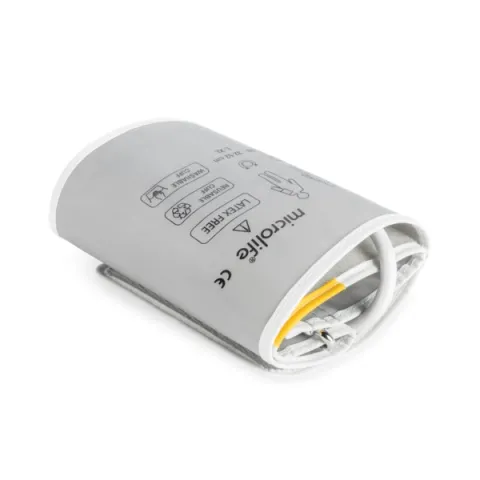
Microlife declares its replacement cuffs compatible with its monitors; the exact list of models is on the sheet of each cuff in the cuffs and adapters category. When applying the cuff, ESH asks for the center of the bladder to sit over the brachial artery, the lower edge 2–3 cm above the elbow crease, and for one finger to fit easily under the edges of the cuff.
Aneroid monitor and spare cuff
How to measure correctly in the office
The procedure recommended by ESH for office measurement:
- A quiet room at a comfortable temperature; no smoking, caffeine, food or exercise in the preceding 30 minutes.
- The patient sits relaxed for 3–5 minutes; neither the patient nor the staff talks during or between readings.
- Back supported by the chair, legs uncrossed, feet flat on the floor; bare arm resting on the table, with the mid-arm at heart level.
- Three readings one minute apart (two if the values are normal), using the average of the last two.
- At the first visit, measure both arms; a systolic difference of more than 10 mmHg is confirmed with repeated readings, after which you use the arm with the higher values.
ESH also calls for annual maintenance to keep the device in good working order.
Thermometers: types and what the data sheet states
| Type | Examples in the catalog | What the sheet states |
|---|
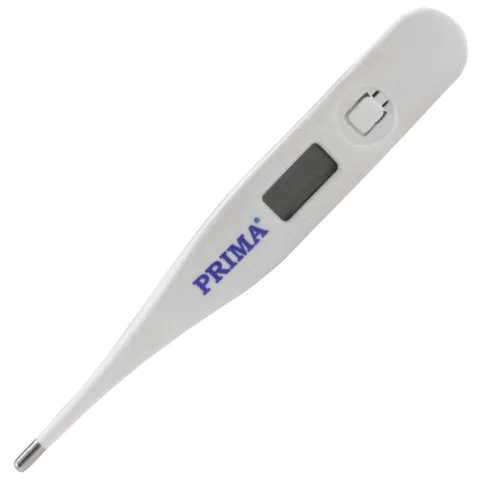
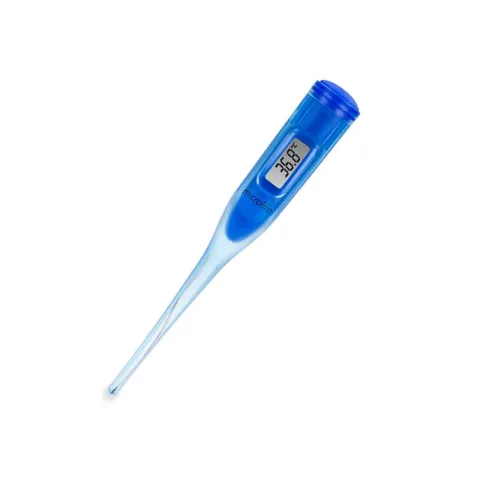
| Digital contact (standard or flexible tip) | PRIMA thermometers with standard and flexible tip, Microlife MT50, Microlife MT700 | PRIMA: display 32.0–42.9 °C, accuracy ±0.1 °C, memory; MT50: 60 seconds, non-metallic tip, water-protected; MT700: 30 seconds, flexible tip, recommended by the manufacturer for rectal measurement |
| Infrared ear | PRIMA ear; PRIMA ear and forehead | 2 seconds, range 32.0–43.0 °C; for comparisons, measure the same ear |
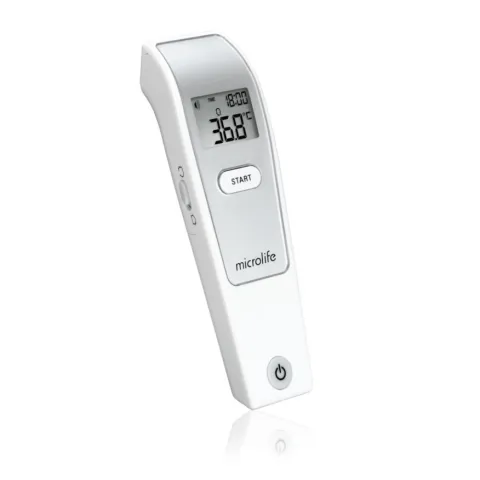
| Infrared non-contact forehead | Microlife NC150, Microlife NC 150 BT, IT-122 | 3 seconds on the Microlife models, body and object modes; the NC 150 BT transfers data via Bluetooth |
Mercury thermometers fall under the same ban in Regulation (EU) 2017/852, which has applied since 31 December 2020. For electrical clinical thermometers, the reference standard is ISO 80601-2-56:2017, which sets out the requirements for basic safety and essential performance; read the accuracy and measuring range on each device’s sheet.
The product sheets in the catalog also contain usage rules that matter in practice: the PRIMA ear thermometer asks you to wait about 20 minutes after exposure to cold or heat, swimming or bathing, and to bring the device into the measuring room about 30 minutes beforehand if it was stored elsewhere; the tip of the PRIMA digital thermometer is disinfected before each use, for example with 70% medical alcohol, and the model is not waterproof. For comparisons over time, use the same device and the same measuring site.
What to check on the packaging and the data sheet
- The exact model and code, so you can find it in validation lists.
- Validation: the protocol used and the independent list in which the model appears.
- The included cuff, with its range in cm, and compatible replacement cuffs.
- Accuracy and measuring range: for example ±3 mmHg on the PRIMA and Microlife AG1-20 mechanical monitors (on the latter, between 18 and 33 °C), ±0.1 °C on the PRIMA digital thermometer.
- Additional functions (AFIB, ABI, two-arm measurement, memory, Bluetooth, mains adapter) and whether they are validated.
- Maintenance: the calibration or check recommended by the manufacturer and the cleaning and disinfection instructions.
- CE mark and notified body number. The European guidance MDCG 2021-24 gives electronic thermometers and electronic blood pressure measuring equipment as examples of class IIa devices, whose conformity is assessed by a notified body; its number appears after the CE mark.
All blood pressure monitors, cuffs, thermometers and stethoscopes are in the health monitoring devices category. Interpreting the readings remains the doctor’s job.
Frequently asked questions
What does it mean that a blood pressure monitor is clinically validated?
That the model has passed an established validation protocol, today the AAMI/ESH/ISO Universal Standard (ISO 81060-2:2018). Check the exact model in independent lists such as STRIDE BP: in the lists of 30 October 2026, the Microlife WatchBP Office ABI (office) and BP B3 AFIB (home) are listed as validated.
Automatic or aneroid blood pressure monitor for a practice?
Validated electronic monitors are increasingly used in practices; aneroid ones are used with a stethoscope, by the auscultatory method, and according to ESH need calibration at least once a year. The choice depends on your protocol and on who takes the readings.
How often should an aneroid monitor be calibrated?
ESH requires aneroid devices to be calibrated at least once a year. Some manufacturers recommend more frequent checks: the PRIMA manual monitor sheet advises checking the static pressure reading every six months.
Which blood pressure cuff do I need?
The one whose range includes the arm circumference, measured at mid-arm. The Microlife cuffs in the catalog cover 17–22 cm (S), 22–42 cm (M-L) and 32–52 cm (L-XL). With electronic devices, use only the cuffs the manufacturer declares compatible.
Are mercury thermometers and blood pressure monitors still sold?
Regulation (EU) 2017/852 has prohibited the manufacture, import and export of non-electronic thermometers and sphygmomanometers containing mercury since 31 December 2020, with a few limited exceptions, such as devices more than 50 years old or museum pieces.
Can I compare an ear reading with a forehead reading?
Not directly. For comparisons, use the same device and the same measuring site; the PRIMA ear thermometer sheet even asks you to measure in the same ear, because the temperature of the two eardrums can differ slightly.