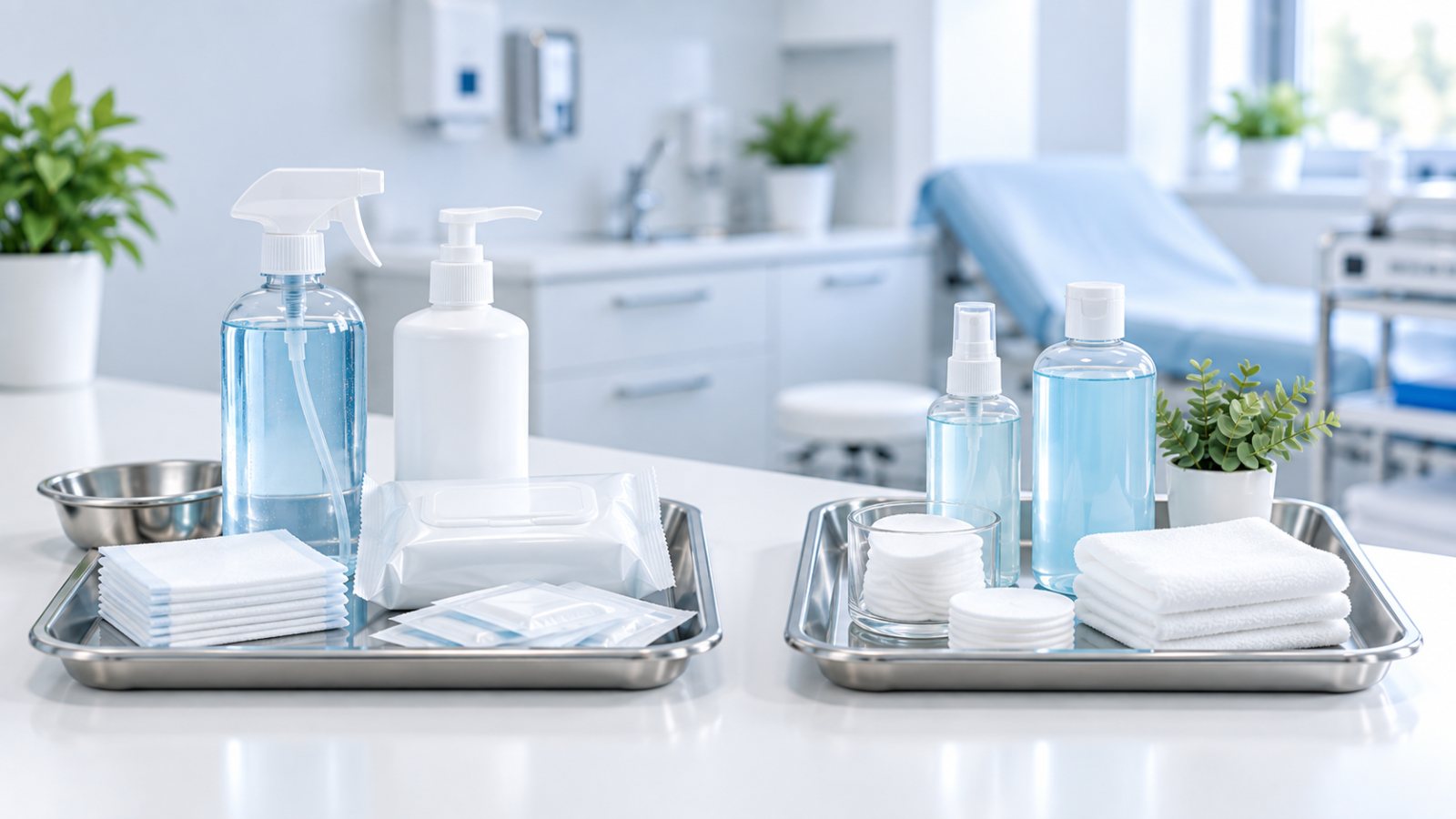
“Disinfectant” and “antiseptic” are often used as synonyms, and many labels even show them together. The difference between them, however, is not a matter of vocabulary: one is a solution made for countertops, instruments and door handles, the other is made for skin, mucous membranes and wounds. If you mix them up, you either fail to protect the patient or irritate their skin for nothing.
This guide explains, step by step, what sets them apart, how alcohol, chlorhexidine and iodine work, why contact time matters more than concentration, how to properly disinfect hands and the patient's skin, what to use on wounds and mucous membranes, and what the EN standards on the label mean. At every step you will find the right products from the Prima Shop catalog.
Disinfectant or antiseptic?
Both destroy or inactivate microorganisms. The difference is what you apply them to, and this determines the concentrations, the permitted substances and the tests the product must pass.
On objects
Disinfectant
- Surfaces, floors, furniture, equipment
- Medical instruments, before sterilization
- Concentrations that would irritate or burn the skin
- Tested on surfaces: EN 13697, EN 16615
vs
On living tissue
Antiseptic
- Staff hands and the patient's skin
- Mucous membranes and wounds, with dedicated products
- Formulated to be tolerated by the skin, often with emollients
- Tested on hands: EN 1500, EN 1499, EN 12791
That is why a countertop spray is not used on hands, no matter how “strong” it is, and hand gel is not designed to disinfect a dental chair.
What the label tells you about the product's classification
| Category | Used for | What to look for on the packaging |
|---|
| Biocide PT1 | Human hygiene: hand and skin disinfection | Biocidal product approval or authorization number |
| Biocide PT2 | Surfaces not in direct contact with people | Approval number, product type PT2 |
| Biocide PT4 | Food-contact surfaces | Approval number, product type PT4 |
| Medical device | Disinfection of medical instruments and devices | CE marking with the notified body number |
| Medicinal product | Antisepsis of wounds and mucous membranes, some skin antiseptics | Marketing authorization and package leaflet |
Biocidal products are regulated by Regulation (EU) No 528/2012, and in Romania they are approved through the National Commission for Biocidal Products (Comisia Națională pentru Produse Biocide). If a product has none of the classifications above, do not use it for medical purposes.
AHow each one works
Active substances, made simple
Almost all skin and hand antiseptics are based on a handful of substances. Each has a strength and a limitation, and combinations bring their advantages together.
| Substance | Speed | Residual effect | On mucous membranes and wounds | Watch out for |
|---|
| Alcohol 60–85% | seconds | none | no | Flammable; does not kill spores; dries the skin without emollients |
| Chlorhexidine | moderate | hours | dedicated products only | Eyes, middle ear; rare allergy; inactivated by soap |
| Povidone-iodine | ≈ 2 min | limited | yes, aqueous | Thyroid, iodine allergy, pregnancy, newborns; stains |
| Alcohol + chlorhexidine | seconds | hours | no | Widely used on the patient's skin before procedures |
| Hydrogen peroxide 3% | moderate | none | occasionally | Damages healing tissue; not in closed cavities |
Alcohol the fastestIt denatures the proteins of microorganisms within seconds. It needs water to work, which is why 60–85% solutions are more effective than concentrated 96% alcohol. It leaves no effect once it evaporates.
Chlorhexidine residual effectIt binds to the outer layer of the skin and keeps working for several hours. It is ideal for the surgical team's hands and for the patient's skin, combined with alcohol for speed.
Povidone-iodine broad spectrumIt gradually releases free iodine, active against bacteria, fungi and many viruses. It only works once it has dried, in about two minutes, and it stains the skin brown, which shows where it has been applied.
Hydrogen peroxide cleans, does not protectThe foam helps loosen debris from a dirty scrape, but its antiseptic effect is weak and short-lived, and repeated use delays healing.
Contact time is what counts
An antiseptic does not work the moment it touches the skin, but during the time it stays on it. The times below are typical values; the exact ones are on each product's label.
Hygienic hand rub with alcohol30 s
Hygienic handwashing with antiseptic soap40 – 60 s
Alcohol with chlorhexidine on the patient's skin, until dry≥ 30 s
Povidone-iodine on the patient's skin, until dry≈ 2 min
Surgical hand rub (EN 12791)1.5 – 3 min
030 s1 min2 min3 min
Dry means effectiveDo not wipe off the antiseptic, do not blow on it and do not cover the area while it is still wet. On wet skin, alcohol stings and disinfects less effectively, iodine does not have time to release free iodine, and during procedures with electrocautery, an alcohol-based antiseptic that has not dried can catch fire.
MThe most effective measure
Hand hygiene: rubbing or washing
The World Health Organization recommends rubbing with an alcohol-based product as the standard method in healthcare facilities: it is faster than washing, more effective on clean hands and, with emollients, gentler on the skin. Soap and water remain mandatory in a few situations.
Alcohol hand rub the ruleOn visibly clean hands, before and after patient contact. Apply the amount stated on the label, usually 3 ml, into a dry palm and rub until dry, about 20–30 seconds.
Washing with soap and water the exceptionWhen hands are visibly dirty or soiled with fluids, after using the toilet and after contact with patients with infectious diarrhea: alcohol does not destroy Clostridioides difficile spores. Washing takes 40–60 seconds.
The 5 Moments for Hand Hygiene (WHO)
- Before touching a patient.
- Before a clean or aseptic procedure.
- After body fluid exposure.
- After touching a patient.
- After touching patient surroundings.
Hand rub technique in 6 steps
- Palm to palmRub palms together until the product covers the entire surface.
- Palm over the back of the other handWith fingers interlaced, then switch hands.
- Palm to palm, fingers interlacedSo the product gets between the fingers.
- Backs of fingers to opposing palmWith fingers interlocked, rub the knuckles.
- Rotational rubbing of the thumbClasp it in the palm of the other hand and rub in circles, then the other thumb.
- Fingertips in the palmRub the fingertips and nails in circles in the opposite palm, backward and forward, until hands are completely dry.
- Alchosept: 85% ethanol with glycerin, for hygienic disinfection in 30 seconds (EN 1500) and surgical disinfection in 90 seconds (EN 12791), active against bacteria, fungi, yeasts and mycobacteria. Bottles from 40 ml to 5 liters.
- Klintensiv Gel: hydroalcoholic gel with 85% ethanol and emollients, contact time 30–90 seconds. For wall-mounted dispensers: the 1.2-liter cartridge and the sensor dispenser.
- Dezidiol Spray: two alcohols and chlorhexidine, hygienic disinfection in 2 × 30 seconds (EN 1500), active against MRSA in 30 seconds (EN 13727). The same formula comes as Dezidiol Wipes.
- Other alcohol-based options: OROMED Gel, fragrance- and dye-free, and Hexy Gel, with 70% alcohols.
Pentru frecarea igienică și chirurgicală a mâinilor
from 5,63 lei
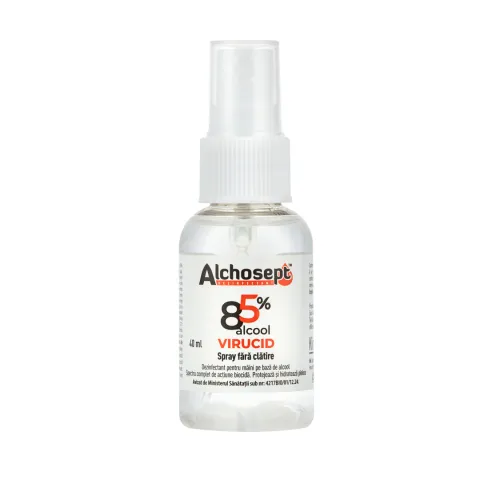
Alchosept Professional Hand and Skin Disinfectant with 85% Alcohol
in stock
11 variante
563Lei
excl. VAT: 4,65 Lei
from 9,95 lei
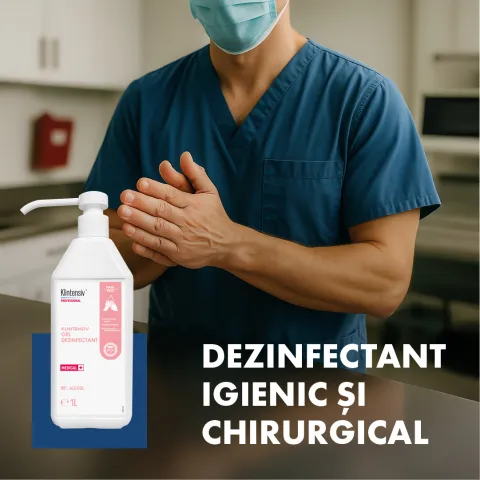
Klintensiv Professional Hand Sanitizer Gel
in stock
11 variante
995Lei
excl. VAT: 8,22 Lei
from 45,00 lei
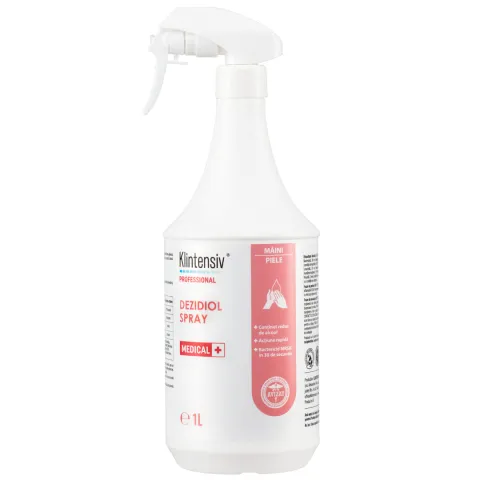
Dezidiol Spray Hand and Skin Disinfectant with Two Alcohols and Chlorhexidine
in stock
3 variante
4500Lei
excl. VAT: 37,19 Lei
Antiseptic soaps
Regular soap mechanically removes dirt and some of the microorganisms. Antiseptic soap adds an active substance, usually chlorhexidine or povidone-iodine, and is used mainly for surgical scrubbing and in high-risk wards. Rinse thoroughly and dry your hands with disposable towels.
- Prestisept: chlorhexidine digluconate 4%, PT1 approval, tested to EN 1499 and EN 12791, bactericidal, yeasticidal and virucidal against enveloped viruses (EN 14476).
- Klintensiv CHDG Soap: chlorhexidine digluconate 4%, for hygienic and surgical handwashing, with a contact time of 1–4 minutes. The 2% version: Davera Soap, with a residual bactericidal effect of up to 6 hours.
- Klintensiv PVP Iodine Soap 7.5%: surgical soap with povidone-iodine and emollients, for those who cannot tolerate chlorhexidine. Fragrance-free: Klinoderm, a disinfectant soap for hygienic and surgical handwashing.
Săpunuri antiseptice și chirurgicale
from 25,91 lei
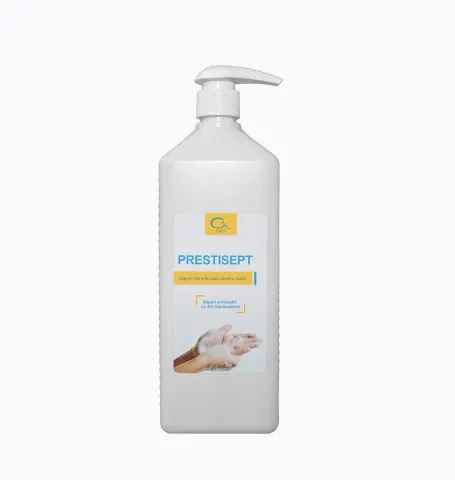
Disinfectant and Antiseptic Liquid Soap for Hands and Skin, Prestisept, BIOCIDE - 1 liter
in stock
3 variante
4680Lei
excl. VAT: 38,68 Lei
from 37,61 lei
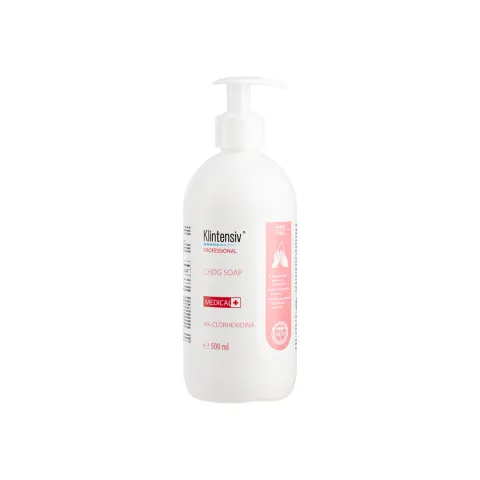
Klintensiv CHDG Soap - Hygienic and Surgical Soap with 4% Chlorhexidine
in stock
5 variante
3761Lei
excl. VAT: 31,08 Lei
from 77,73 lei
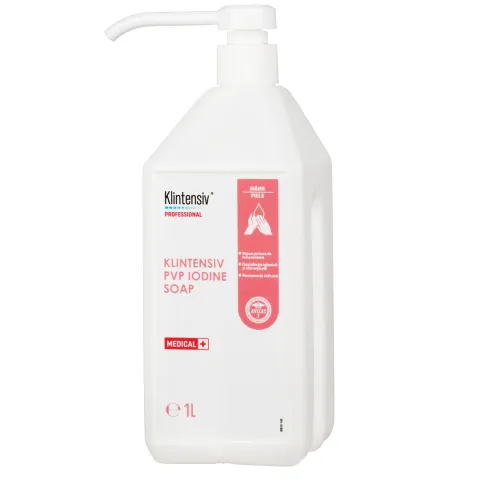
Klintensiv PVP Iodine Soap 7.5% Surgical Soap
in stock
3 variante
7773Lei
excl. VAT: 64,24 Lei
PBefore procedures
The patient's skin
The skin has its own flora, and some of it is carried deeper with every puncture or incision. Skin antisepsis reduces this risk. How rigorous it needs to be depends on the procedure.
| Procedure | Usual antiseptic | Keep in mind |
|---|
| IM or SC injection, routine blood draw | 70% alcohol swab | In a single pass, then wait for it to dry |
| Blood cultures | Alcohol with chlorhexidine or povidone-iodine | Do not palpate the vein again after disinfection; observe the drying time |
| Inserting an IV cannula | Alcohol with chlorhexidine | Let the skin dry completely before puncture |
| Central venous catheter, punctures | Chlorhexidine above 0.5% in alcohol | Alternative in case of allergy: povidone-iodine |
| Surgical procedures | Chlorhexidine or povidone-iodine, in alcoholic solution | Complete drying before sterile drapes and electrocautery |
The table is for guidance only. The choice of product and technique is determined by the facility's protocol and the physician, especially for newborns, pregnant women and patients with allergies.
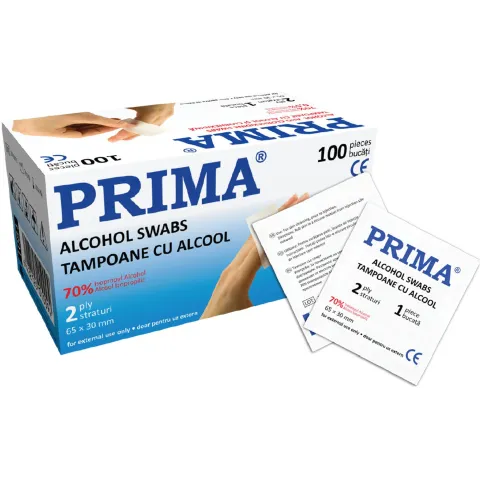
- PRIMA swabs impregnated with 70% isopropyl alcohol: sterile, individually packed, for intact skin before injections and blood draws. Also available in boxes of 200.
- Iodine alcohol: povidone-iodine 10% (equivalent to 1% iodine) in alcoholic solution, for local skin disinfection. Apply around the wound, not on the wound.
- IODINE “T” solution: iodine-based, for preoperative disinfection of skin and mucous membranes and for antisepsis of superficial wounds and burns, undiluted or diluted with water or saline solution. For skin and hands with povidone-iodine 7.5%: Betaklin.
- With chlorhexidine and alcohols, for hands and skin: Hexid, with chlorhexidine digluconate 0.5%, ethanol and isopropanol, PT1 approval.
Pentru pielea pacientului
PRIMA Sterile Alcohol Prep Pads, 6.5 x 3 cm, 100 pcs
in stock
666Lei
excl. VAT: 5,50 Lei
Promoted i
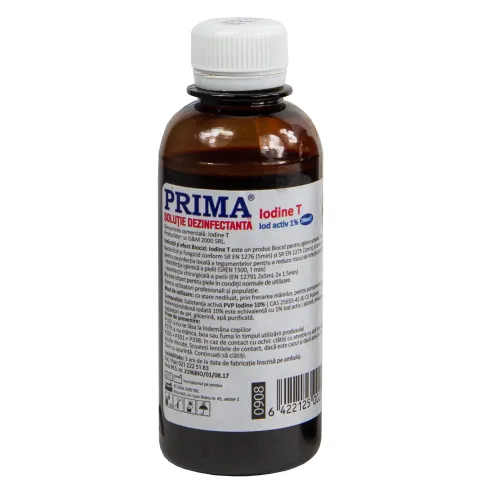
Povidone-Iodine Solution, 10%, 200ml, PRIMA
in stock
2541Lei
excl. VAT: 21,00 Lei
from 24,81 lei
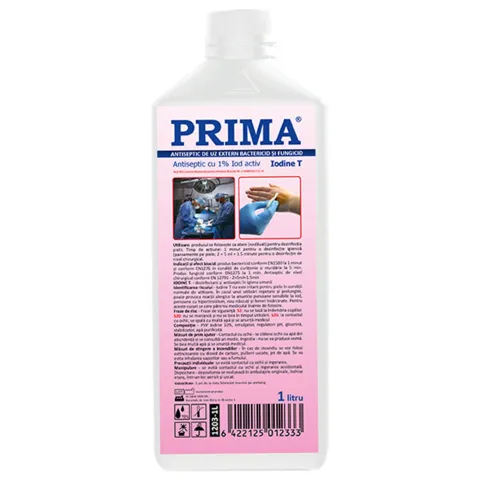
Iodine T - Iodine-Based Skin Disinfectant, PVP-Iodine 10%
in stock
2 variante
7600Lei
excl. VAT: 62,81 Lei
RSensitive tissue
Wounds and mucous membranes
On a wound, the first step is not the antiseptic but cleaning: rinsing with saline solution or drinking water and removing debris and dirt. Antiseptics have their place on contaminated wounds or wounds at risk of infection, for a limited period. On mucous membranes, only alcohol-free products made specifically for them are used.
Rules for wounds and mucous membranes
- No alcohol on open wounds or mucous membranes: it hurts, irritates and destroys the cells that repair tissue.
- Hydrogen peroxide only occasionally, to loosen dirt from a scrape, not daily on a healing wound and never in deep wounds or closed cavities.
- Povidone-iodine is used on infected superficial wounds and minor burns, for short periods and not on large areas.
- Chlorhexidine on the oral mucosa only in low concentrations, as a mouthwash. With long-term use, it can stain teeth and alter taste.
- A wound that becomes red, swollen, increasingly painful or discharges pus should be seen by a doctor, not treated with another antiseptic.
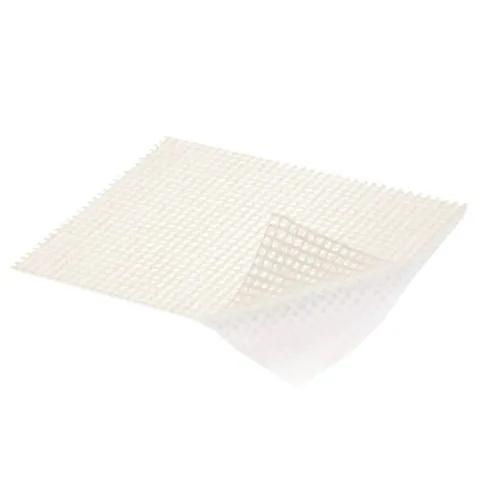
- Sterile povidone-iodine 10% gauze pads: antiseptic dressings made of ointment-impregnated viscose, 10 × 10 cm, for infected superficial wounds, minor burns, cuts and infected ulcers.
- Hydrogen peroxide 3%, for external use, for occasional cleaning of superficial wounds. Also in 85 ml and 1-liter bottles.
- KLINDENT: alcohol-free professional mouthwash with chlorhexidine digluconate 0.12%, 10–15 ml for 30–60 seconds, after brushing.
- For wet compresses on superficial wounds, the traditional Rivanol 0.1% solution, to be stored away from light.
Pentru plăgi și mucoase
Povidone-Iodine 10% Gauze Dressings 10x10cm, Sterile, 50 pcs
in stock
16940Lei
excl. VAT: 140,00 Lei
Promoted i
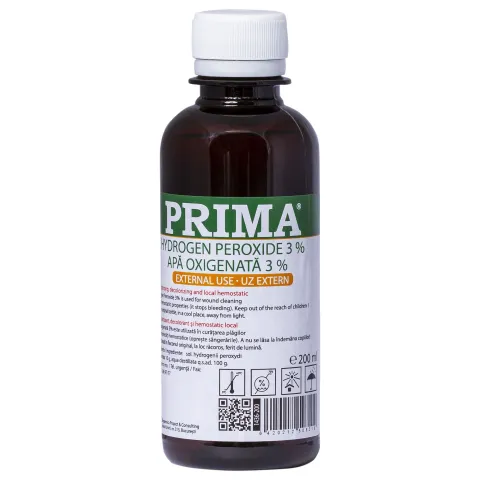
PRIMA Hydrogen Peroxide 3% 200 ml, Antiseptic, Hemostatic, for Wounds and Oral Hygiene
in stock
641Lei
excl. VAT: 5,30 Lei
from 23,60 lei
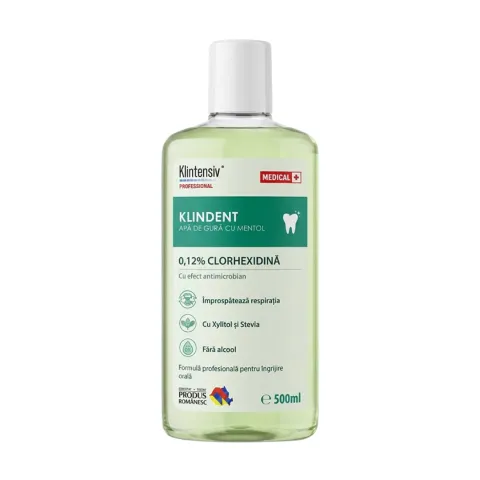
KLINDENT Professional Mouthwash with Chlorhexidine 0.12%
in stock
7 variante
2360Lei
excl. VAT: 19,50 Lei
What the standards on the label mean
A “bactericidal and virucidal” product doesn't tell you much without the standard it was tested to. The standard shows what it was tested on, under what conditions and how long it must be left to act.
EN 1500 hand rubHygienic hand disinfection by rubbing. The product is compared, on volunteers, with an isopropanol reference solution and must be at least as effective.
EN 1499 handwashingHygienic handwashing with antiseptic soap, compared with washing with regular soap.
EN 12791 surgicalSurgical hand disinfection, with immediate effect and after 3 hours under gloves. The tested time, usually 1.5–3 minutes, is the one you must follow.
EN 13727 and EN 13624 bacteria and fungiSuspension tests for the medical area: bactericidal (EN 13727), yeasticidal and fungicidal (EN 13624). For mycobacteria and tuberculosis, EN 14348.
EN 14476 virusesRead the full claim: “enveloped viruses” (influenza, coronavirus, HBV, HCV, HIV), “limited spectrum” (plus adenovirus and norovirus) or “full virucidal” (plus poliovirus, the most resistant).
EN 13697 and EN 16615 surfacesSurface tests for disinfectants. EN 16615 simulates wiping with cloths or wipes in the medical area. They have nothing to do with skin.
What about surface disinfectants?
Surfaces around the patient are cleaned and disinfected with PT2 products, on a set schedule: frequently touched surfaces after each patient, the rest daily. You will find the complete guide in the Quick Guide to Surface Disinfection in the Practice, and the difference between a virucidal product and a merely sanitizing one is explained here.
Dezinfectanți pentru suprafețe
from 18,00 lei
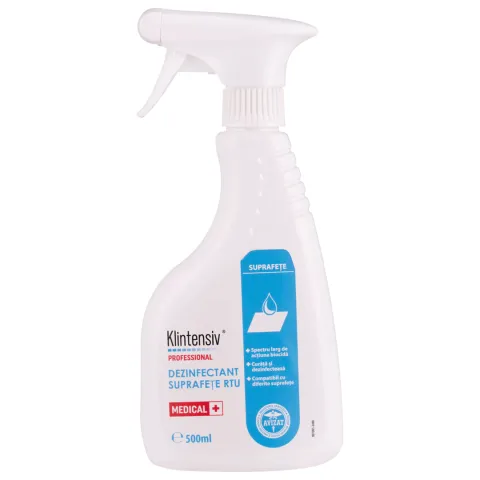
Klintensiv Ready-to-Use Surface Disinfectant
in stock
5 variante
1800Lei
excl. VAT: 14,88 Lei
from 21,21 lei
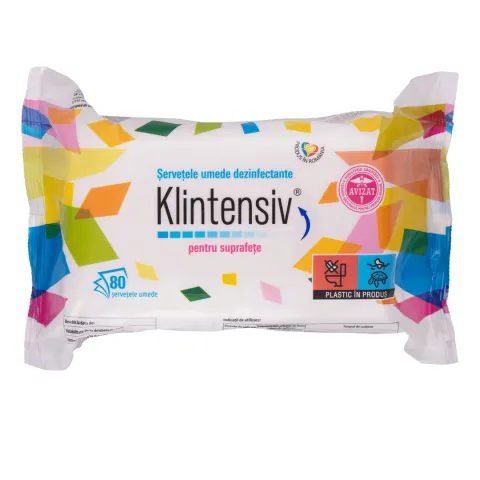
Klintensiv Surface Disinfectant Wipes
in stock
4 variante
2121Lei
excl. VAT: 17,53 Lei
from 28,11 lei
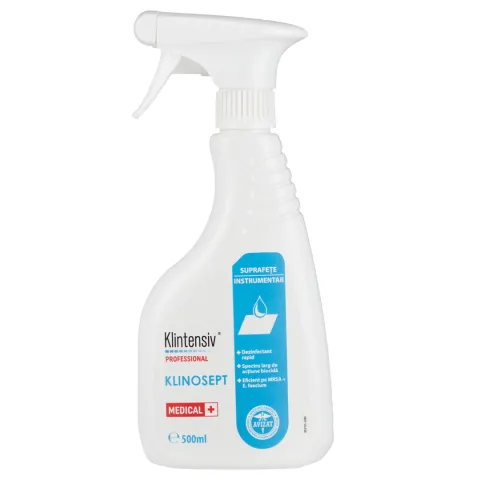
Klinosept Alcohol-Based Rapid Surface Disinfectant
in stock
5 variante
2811Lei
excl. VAT: 23,23 Lei
Common mistakes
- Using surface disinfectant on hands or skinThe concentrations and substances are not made for living tissue. Use only products labeled for “hands”, “skin” or “integument”.
- Putting alcohol on an open woundIt hurts, irritates and delays healing. Clean the wound with saline solution and choose an antiseptic intended for wounds.
- Wiping off or covering the antiseptic before it driesYou lose exactly the time during which it works. Iodine needs about two minutes.
- Washing your hands and immediately rubbing them with alcoholOn wet hands, alcohol gets diluted. Choose one method or dry your hands thoroughly first.
- Topping up a half-empty bottleRefilled containers become contaminated. Empty, clean and replace them, or use disposable cartridges.
- Pouring antiseptic into unlabeled bottlesYou lose the product name, batch, expiry date and instructions, and risk confusion with other solutions.
- Using chlorhexidine after regular soap without rinsingAnionic soaps inactivate it. Rinse thoroughly or use antiseptic chlorhexidine soap.
- Wearing rings, bracelets or artificial nailsMicroorganisms remain underneath them where the antiseptic cannot reach.
Antiseptics a practice should keep on hand
Team's hands- Alcohol-based gel or solution at every workstation
- Liquid soap and disposable towels
- Antiseptic soap, if procedures are performed
- Hand cream for the end of the day
Patient's skin- Sterile 70% alcohol swabs
- Alcohol with chlorhexidine for IV cannulas and punctures
- Povidone-iodine, as an alternative in case of allergy
- Sterile gauze swabs
Wounds and mucous membranes- Saline solution for cleaning
- Povidone-iodine gauze pads
- Chlorhexidine mouthwash, in dentistry
- Sterile dressings
Professional antiseptics and disinfectants, delivered by Prima Shop
Hand and skin disinfectants, surgical soaps, iodine and alcohol solutions, wound care products and surface disinfectants, with approvals and technical data sheets, invoiced to your company.
Frequently asked questions
Is rubbing alcohol a good antiseptic?
On intact skin, yes: 70% alcohol disinfects quickly, for example before an injection. However, it has no residual effect, it is not used on wounds and mucous membranes, and frequent use on hands without emollients dries the skin. For hands, professional hydroalcoholic solutions are gentler and tested to EN 1500.
Can I use hand gel on the patient's skin?
Only if its label also mentions skin or integument. Many products, such as Alchosept or Dezidiol, are for “hands and skin”; others are for hands only.
Chlorhexidine or iodine before a procedure?
For most procedures, international guidelines prefer chlorhexidine in alcoholic solution, because it works quickly and has a residual effect. Povidone-iodine is the alternative for patients allergic to chlorhexidine. For newborns, pregnant women and patients with thyroid conditions, the physician decides.
Do antiseptics also kill viruses?
It depends on the product. Look for the EN 14476 standard on the label and the exact claim: many alcohol-based antiseptics are active against enveloped viruses, such as influenza viruses and coronaviruses, but less so against non-enveloped viruses, such as norovirus.
Is it a good idea to put hydrogen peroxide on a wound?
Only occasionally, to loosen dirt from a scrape. For routine wound cleaning, saline solution is more suitable: hydrogen peroxide also damages the cells that repair tissue.
How long does an antiseptic keep after opening?
As long as the label states, usually until the expiry date, if the bottle is tightly closed and kept away from heat and light. Do not transfer the product to other containers and do not top up opened bottles.